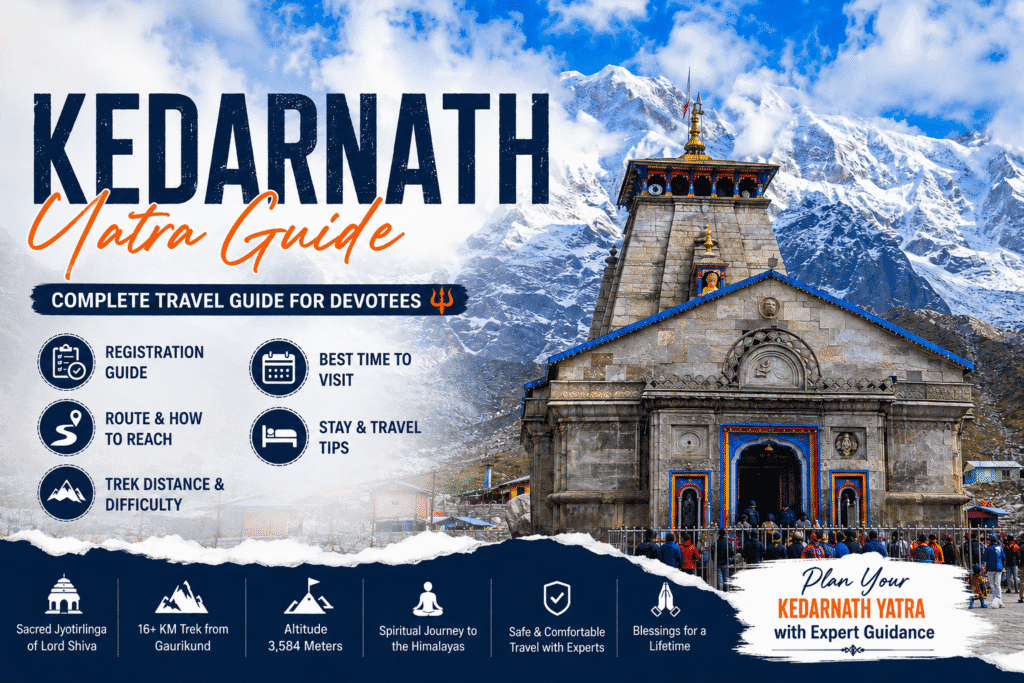
Kedarnath is one of the most spiritually powerful pilgrimages in India. Tucked deep in the Garhwal Himalayas of Uttarakhand, this ancient shrine draws lakhs of devotees every season who trek through mountain trails to seek the blessings of Lord Shiva. Whether it’s your first Kedarnath trip or you’re comparing a Kedarnath Yatra package against planning it yourself, this guide covers everything from history and route to registration and packing.
Kedarnath is a 3,583 m high Himalayan shrine in Rudraprayag district, Uttarakhand. The nearest roadhead is Gaurikund, from where pilgrims trek 16–18 km (or take a helicopter) to reach the temple. The best time to visit is May–June or September–October, and registration on the official Uttarakhand Char Dham portal is mandatory before travel.
Where Is Kedarnath Located?
Kedarnath Temple sits at an altitude of roughly 3,583 metres in the Rudraprayag district of Uttarakhand, near the source of the Mandakini River, encircled by peaks like the Kedarnath Dome and the Chaukhamba range. Because heavy snowfall cuts the region off in winter, the shrine stays open to pilgrims for only about six months each year — the rest of the time, the deity is worshipped at Ukhimath. The last stretch to the temple isn’t accessible by any vehicle; from Gaurikund, the nearest roadhead, pilgrims must trek roughly 16–18 km on foot, pony, palki, or helicopter.
Mythology & Spiritual Significance
Kedarnath is one of the twelve Jyotirlingas of Lord Shiva — sites believed to house his divine energy as a column of light. Unlike most Jyotirlingas located in cities, Kedarnath stands alone in the high mountains, symbolising detachment and closeness to the divine.
According to legend, after the Kurukshetra war, the Pandavas sought forgiveness from Lord Shiva for killing their own kin. Shiva evaded them by taking the form of a bull; when Bhima tried to catch it, the bull began sinking into the earth. Its hump surfaced at Kedarnath, while other parts appeared at four nearby sites, together forming the Panch Kedar temples — Tungnath, Rudranath, Madhyamaheshwar, and Kalpeshwar.
The temple in its current form is believed to have been re-established in the 8th century by Adi Shankaracharya, who revived Hindu pilgrimage traditions across India. He is also believed to have attained Samadhi near the temple, and his memorial stands just behind the main shrine today. Built from massive interlocking stone slabs without any cement, the structure has survived earthquakes, avalanches, and extreme Himalayan weather for centuries.
Kedarnath After the 2013 Floods
In June 2013, extreme rainfall triggered flash floods and landslides across the Kedarnath valley, causing severe destruction and loss of life. Remarkably, the temple structure itself remained largely untouched — a massive boulder, now called Bhim Shila, lodged itself just behind the temple and diverted the flood debris around it. Many devotees see this as a sign of divine protection.
Since then, the region has been rebuilt with wider trekking paths, better medical camps, improved crowd management, upgraded accommodation, and expanded helicopter services — making today’s Kedarnath Yatra safer and better organised than before.
Best Route to Kedarnath from Dehradun, Haridwar & Rishikesh
By Air: The nearest airport is Jolly Grant Airport in Dehradun, with regular flights from Delhi and other cities. From here, taxis run to Rudraprayag, Guptkashi, or Sonprayag. Helicopter services operate from Phata, Sersi, and Guptkashi — book well in advance during peak season.
By Rail: The closest stations are Haridwar and Rishikesh, both well connected to major Indian cities. From either, buses and taxis continue toward Guptkashi or Sonprayag.
By Road (from Dehradun): The typical route is Dehradun → Rishikesh → Rudraprayag → Guptkashi → Sonprayag → Gaurikund, covering roughly 210–220 km in about 8–10 hours. The mountain stretches are narrow and winding, so an experienced local driver makes a real difference — something we arrange as part of every Chaukhamba Travels itinerary.
Gaurikund to Kedarnath Trek – Distance, Time & Difficulty
- Distance: Approximately 16–18 km one way
- Duration: 6–9 hours, depending on fitness and weather
- Altitude gain: From about 1,982 m at Gaurikund to 3,583 m at Kedarnath
- Difficulty: Moderate — a steady, continuous climb rather than technical terrain
You can cover this on foot, by pony/mule, palki (palanquin), or helicopter. The trail passes through rest points like Jungle Chatti, Bheembali, and Linchauli, offering food stalls, medical aid, and places to pause. Since the 2013 rebuild, the path has been considerably widened and better maintained.
Best Time to Visit & Weather Guide
| Period | Day Temp | Conditions |
| May – June | 10°C – 20°C | Stable, clear, peak crowd |
| July – August | 8°C – 18°C | Monsoon, landslide risk — best avoided |
| September – October | 8°C – 15°C | Clear skies, fewer crowds, ideal |
| November – April | Sub-zero | Temple closed, heavy snow |
Even in warmer months, temperatures drop sharply after sunset, so warm layers are essential regardless of when you travel.
Temple Opening & Closing Dates
The temple traditionally opens on Akshaya Tritiya (late April or early May) and closes around Bhai Dooj in November, with exact dates fixed by temple priests and announced each year closer to the season. Since the yatra window is short, confirm current dates before finalising travel and book early once they’re out.
Kedarnath Yatra Registration – Step by Step
Registration is mandatory for every pilgrim, helping authorities manage pilgrim flow and respond quickly in emergencies.
- Visit the official Uttarakhand Char Dham registration portal or the Tourist Care Uttarakhand app
- Enter personal and travel details
- Upload a valid government ID
- Complete biometric verification where required
- Download and carry the printed confirmation/QR code
Entry can be restricted without valid registration, so complete it well ahead of travel. At Chaukhamba Travels, we handle registration assistance as part of our Char Dham packages.
Places to Explore Near Kedarnath
Bhairavnath Temple — About 500 m uphill, dedicated to Bhairav Baba, believed to guard the temple through winter, with sweeping valley views.
Vasuki Tal — A glacial lake around 8 km from Kedarnath at roughly 4,150 m; the trek is demanding and best suited to experienced trekkers.
Gaurikund — The trek’s starting point, known for its natural hot springs where pilgrims bathe before the climb.
Chorabari Tal (Gandhi Sarovar) — A small glacial lake 3–4 km from the temple, where part of Mahatma Gandhi’s ashes were immersed.
Common Mistakes Pilgrims Make
- Skipping physical preparation — start light walking or cardio a couple of weeks before your trip
- Traveling without warm layers in summer — nights and upper trek stretches turn cold fast
- Booking hotels/helicopter too late — peak season demand outstrips supply quickly
- Delaying registration — slots fill up fast and travel can be blocked without a valid pass
- Starting the trek too late in the day — mountain weather changes fast in the afternoon
- Overpacking — every extra kilogram matters on a 16–18 km climb
Kedarnath Yatra Cost Breakdown
| Expense Head | Approx. Range (per person) |
| Transport (Dehradun–Sonprayag, round trip) | ₹4,000 – ₹7,000 |
| Accommodation (2–3 nights) | ₹3,000 – ₹10,000 |
| Pony / Palki (optional) | ₹3,000 – ₹8,000 |
| Helicopter (one way, if chosen) | ₹4,500 – ₹6,500 |
| Food & miscellaneous | ₹1,500 – ₹3,000 |
| Total (road trip) | ₹18,000 – ₹35,000 |
| Total (with helicopter) | ₹35,000 and above |
These figures vary with season, hotel category, and group size — a customised quote from your travel agency is always more accurate than a general estimate.
Essential Packing & Travel Tips
Warm layered clothing, a raincoat or poncho, sturdy trekking shoes, personal medication and a basic first-aid kit, a power bank and flashlight, printed ID/registration copies, light snacks, and a reusable water bottle. Those with heart, respiratory, or blood pressure conditions should consult a doctor beforehand and consider pony, palki, or helicopter over walking.
Why Travel with Chaukhamba Travels
As a Dehradun-based travel agency, we plan Kedarnath trips around the route we know best — starting right from your pickup point in Dehradun. That means registration handled on your behalf, vetted hotels booked in advance even during peak season, experienced local drivers for the mountain stretches, both road and helicopter itineraries customised to your budget, and a single point of contact via WhatsApp throughout your trip.
Take a look at our Char Dham Yatra Packages to see current itineraries and pricing, or message us directly for a custom plan.
Frequently Asked Questions
1. How far is the Gaurikund to Kedarnath trek? Around 16–18 km one way, coverable on foot, pony, palki, or helicopter.
2. What is the best time to visit Kedarnath? May–June and September–October offer the most stable weather and manageable trekking conditions.
3. Is Kedarnath Yatra registration mandatory? Yes, every pilgrim must register through the official Uttarakhand Char Dham portal before starting the yatra.
4. Can senior citizens complete the Kedarnath Yatra? Yes, many do — usually via pony, palki, or helicopter rather than walking the full distance.
5. How many days does a Kedarnath trip from Dehradun typically take? Around 4–5 days including travel, the trek, darshan, and return.
6. Should I book a package or plan the trip myself? Packages offer convenience and are easier for families or first-timers; self-planning offers flexibility but needs more coordination — it depends on your comfort level and time available.
Conclusion
The Kedarnath Yatra is as much an inward journey as an outward one — a mix of faith, endurance, and quiet moments in the mountains. With the route, registration, and season sorted out in advance, the trip becomes far less about logistics and far more about the experience itself. Whether you choose to walk the full trail, take a pony, or opt for a quick helicopter darshan, a little planning goes a long way toward making the journey smooth and memorable.
Ready to Plan Your Kedarnath Yatra?
At Chaukhamba Travels, we take care of everything — transport from Dehradun, hotel bookings, registration assistance, and on-ground support — so you can focus on the pilgrimage itself.
Planning to cover the full Char Dham circuit? Read our Badrinath Dham travel guide and Gangotri Dham Yatra guide for the rest of your journey.
📞 Explore our Char Dham Yatra Packages 💬 Chat with us on WhatsApp for a customised itinerary and pricing