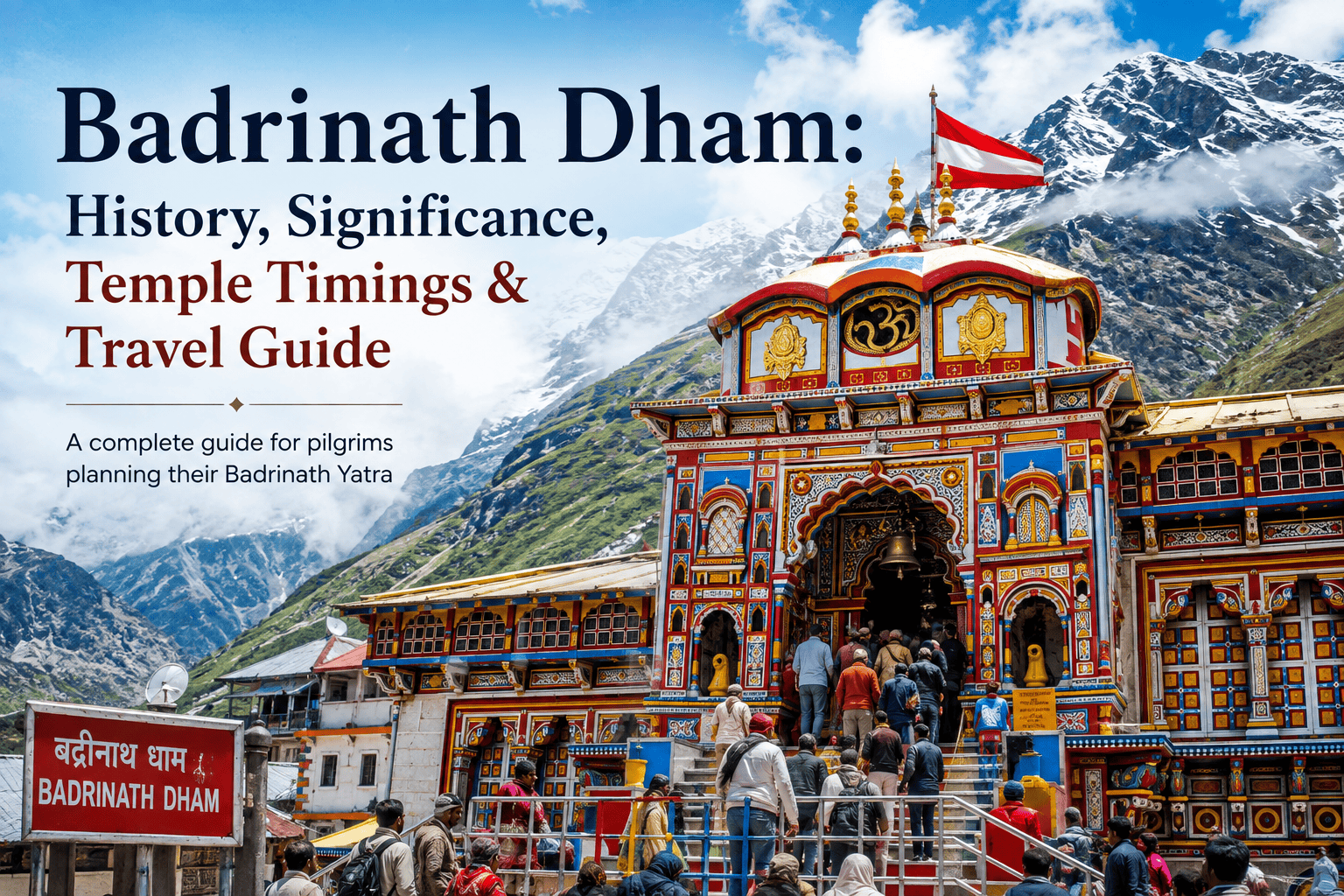
Badrinath Dham is a sacred Hindu temple dedicated to Lord Vishnu, worshipped here as Badrinarayan. It sits in Chamoli district, Uttarakhand, at an altitude of about 3,133 metres (10,279 feet) in the Garhwal Himalayas, beside the Alaknanda River. It is the final and most important stop on the Uttarakhand Char Dham Yatra. According to the official Uttarakhand Tourism portal, the temple’s kapat (gates) opened for the 2026 season on 23 April 2026 at 6:15 AM, and it is expected to close around 13 November 2026 (Bhai Dooj). Daily darshan generally runs 4:30 AM–1:00 PM and 4:00 PM–9:00 PM.
Badrinath Dham isn’t just a temple visit — it’s a multi-day Himalayan journey. Knowing the history, the religious significance, the opening season, the route, registration requirements, and nearby places to see can make the difference between a rushed trip and a well-planned pilgrimage. This guide covers everything a first-time or returning pilgrim needs to know.
What Is Badrinath Dham?
Badrinath Dham is a sacred Hindu pilgrimage site dedicated to Lord Vishnu. The main shrine, Badrinath Temple, stands in the Himalayan town of Badrinath, close to the Alaknanda River and framed by the Nar and Narayan mountain ranges. Hindu tradition ties the site closely to Vishnu’s worship, and it remains one of the most visited pilgrimage destinations in Uttarakhand today.
Badrinath is one of the four sites of the Uttarakhand Char Dham Yatra, alongside Yamunotri, Gangotri, and Kedarnath. The high-altitude setting makes this a different kind of trip from an ordinary temple visit — weather, road conditions, accommodation, and altitude all need to factor into your planning.
Where Is Badrinath Temple Located?
Badrinath Temple is located in Chamoli district, Uttarakhand, deep in the Garhwal Himalayas, at an elevation of roughly 3,133 metres (10,279 feet). The town sits on the banks of the Alaknanda River, with the Nar and Narayan peaks rising on either side and Neelkanth Peak visible behind the temple.
The town is road-connected to several key stops along the yatra circuit, including Rishikesh, Haridwar, Devprayag, Srinagar, Rudraprayag, Karnaprayag, Chamoli, and Joshimath. For most pilgrims, Rishikesh and Haridwar serve as the practical starting points for the road journey ahead. The location also makes it easy to combine Badrinath with other Himalayan pilgrimage and sightseeing stops in the region.
History of Badrinath Dham
Badrinath’s history stretches back to the Vedic era, with mentions across the Puranas, but its life as an organized pilgrimage centre is closely tied to one figure: Adi Shankaracharya.
Historical accounts credit the foundation of the present temple to Shankaracharya, who is said to have discovered a black-stone (shaligram) image of Lord Badrinarayan in the Alaknanda River and enshrined it in a cave near the Tapt Kund hot springs. In the 8th or 9th century CE, Shankaracharya travelled the length of India reviving major pilgrimage sites, and Badrinath became a central stop in that mission.
There’s also an intriguing theory about the site’s earlier life. Some historians and ancient texts suggest the temple may originally have been a Buddhist monastery, converted into a Hindu shrine after Shankaracharya’s visit — a claim partly supported by the temple’s distinctive, brightly coloured facade, which visually echoes Buddhist monastic architecture found elsewhere in the Himalayas.
The idol didn’t stay in its original spot. In the 16th century, the King of Garhwal moved the murti from its cave near Tapt Kund to the temple’s present location. Over the centuries that followed, the shrine went through repeated rounds of renovation and expansion, largely under the patronage of Garhwal kings — a reflection of how challenging it is to maintain a major religious structure in a high-altitude Himalayan environment.
The temple has also weathered natural disasters. It suffered structural damage in an 1803 Himalayan earthquake and was later restored with support from the Jaipur royal family, underscoring how far Badrinath’s reputation had already spread beyond the region by that point.
One tradition from Shankaracharya’s era survives to this day: the temple’s priests are Nambudiris, a Brahmin community he specifically brought from Kerala to maintain the shrine — even though Badrinath sits more than 3,000 kilometres north of Kerala.
Mythology and Religious Significance
Badrinath’s spiritual weight comes from several overlapping legends found across Hindu scripture:
Vishnu’s eternal penance. Hindu mythology holds that Lord Vishnu meditated in this area for thousands of years in the form of a berry (badri in Hindi) — giving the site its name, Badri-Vishal. In the most commonly told version, Goddess Lakshmi transformed herself into a berry tree to shield Vishnu from the harsh Himalayan elements during his meditation, an act of devotion that gave the shrine its enduring name.
Shiva and Parvati’s connection. Popular legend holds that before it became Vishnu’s abode, Lord Shiva resided at Badrinath, and Vishnu acquired the site from him through clever means, turning it into his own sanctuary. This is part of why nearby Kedarnath (Shiva’s shrine) and Badrinath (Vishnu’s shrine) are so often visited together as complementary pilgrimages.
Samudra Manthan link. Some traditions connect Badrinath to the cosmic churning of the ocean (Samudra Manthan), during which Vishnu consumed poison to protect creation and retreated to the Himalayas to recover — with Badrinath believed to be that place of retreat and healing.
The Mahabharata connection. The epic describes the Pandavas passing through the Badrinath region on their final journey toward the Himalayas in search of moksha (liberation), adding another layer of epic-scale significance to the site.
Two nearby sites round out the pilgrimage experience:
- Tapt Kund — A natural hot-water spring close to the temple, traditionally considered a sacred bathing site. Pilgrims bathe here before entering for darshan, believing the mineral-rich water carries both spiritual and physical benefits.
- Brahma Kapal — A riverside ghat near the temple associated with shraddh and pind daan (ancestral rites). Tradition holds that Lord Brahma resides here and relieves ancestors of their past sins — making Badrinath a place of remembrance for the departed, not just the living.
Because of this dense mythological history, the Skanda Purana famously declares that there is no shrine on heaven, earth, or the underworld equal to Badrinath.
Why Is Badrinath Part of Char Dham?
This is a common point of confusion, since the term “Char Dham” is used in two different ways.
The original Char Dham (traditionally associated with Adi Shankaracharya) refers to four pilgrimage sites spread across India:
- Badrinath in the north
- Dwarka in the west
- Jagannath Puri in the east
- Rameswaram in the south
The Uttarakhand Char Dham Yatra is a separate, smaller circuit entirely within Uttarakhand:
Badrinath is the only site that belongs to both circuits, which is part of why it holds such an elevated status among Hindu pilgrimage destinations. When people say “Char Dham Yatra” in the context of a Himalayan pilgrimage trip, they almost always mean the Uttarakhand circuit — but it’s worth knowing the distinction, since travellers often use the two terms interchangeably.
Badrinath Temple Architecture
Badrinath Temple is instantly recognisable for its brightly painted, cone-shaped facade and gold-gilded roof — a style that sets it apart from typical North Indian temple architecture. The structure stands roughly 15 metres (50 feet) tall with a small cupola on top. The sanctum houses the black stone idol of Lord Badrinarayan in a meditative posture, flanked by other deities including Nar-Narayan, Uddhava, Kubera, Garuda, and Narada.
Vehicles are permitted up to the main entrance gate; from there, a paved walking path of about 100 metres leads to the temple sanctum. There is no strict official dress code, but modest, traditional clothing is expected, and photography or mobile phone use is not permitted inside the sanctum.
The combination of the temple, the Alaknanda River, and the surrounding snow-capped peaks gives Badrinath a visual character that’s as striking as its spiritual one.
Temple Timings and Opening/Closing Dates 2026
Badrinath is not a year-round temple. Because of extreme Himalayan winters, the shrine follows a strict seasonal calendar, and the deity is moved to a winter shrine when the temple closes.
| Detail | 2026 Information |
| Opening date | 23 April 2026, 6:15 AM |
| Expected closing date | Around 13 November 2026 (Bhai Dooj) |
| Season length | Roughly late April to mid-November |
| Winter deity worship | Nar Singh Temple, Joshimath |
| Elevation | ~3,133 m / 10,279 ft |
The opening date isn’t fixed on the Gregorian calendar — it’s announced fresh each year. Traditionally, the opening date is declared on Basant Panchami, and the closing date is announced around Vijayadashami (Dussehra). Once the temple closes for winter, pilgrims shift their worship to the Nar Singh Temple in Joshimath, where the deity is honoured until the next season begins.
Note: Opening and closing dates shift slightly every year based on the Hindu Panchang (calendar) and are set by the Shri Badarinath-Kedarnath Temple Committee (BKTC). Always verify the current year’s exact dates closer to your travel — this article reflects the dates announced for the 2026 season.
Aarti and Darshan Schedule
During the open season, the temple follows a structured daily schedule:
- Morning darshan: 4:30 AM – 1:00 PM
- Midday closure: 1:00 PM – 4:00 PM (for bhog offerings and rituals)
- Evening darshan: 4:00 PM – 9:00 PM
Key daily rituals include the Maha Abhishek and Shringar Darshan in the early morning, followed by regular darshan through the day, and the Shayan Aarti in the evening before the temple closes for the night. Exact aarti timings can shift slightly around major festival days, so it’s worth confirming locally once you arrive.
Best Time to Visit
- May–June: Pleasant weather, the most popular window, but also the most crowded.
- September–October: Cooler, clearer skies, thinner crowds — many consider this the best overall season.
- July–August (Monsoon): Best avoided — heavy rain increases the risk of landslides along the mountain roads.
- Late October–mid-November: Very cold but manageable for those who want a quieter, less crowded darshan just before closing.
Badrinath Yatra Registration
Registration is mandatory for all pilgrims on the Char Dham Yatra, including those visiting Badrinath. The official Uttarakhand Tourist Care portal and the Uttarakhand Tourist Care app handle registration and issue a QR-code e-pass that’s checked at multiple points along the route, including Rishikesh, Sonprayag, and Joshimath. The Shri Badarinath-Kedarnath Temple Committee also advises pilgrims to complete all formalities before starting the yatra, since requirements can change from season to season.
Before travelling, keep the following accessible (digital backups are a good idea):
- Valid identity document
- Yatra registration details / e-pass
- Hotel or accommodation confirmation
- Travel booking details
- Emergency contact information
- Relevant medical documents, if applicable
Don’t rely on registration steps from an old article or outdated blog — always confirm the current process on the official portal shortly before you travel.
How to Reach Badrinath
Badrinath has no airport or railway station of its own — the final stretch is always completed by road.
By Road
This is how most pilgrims complete the journey. A common route from Rishikesh runs:
Rishikesh → Devprayag → Srinagar → Rudraprayag → Karnaprayag → Nandprayag → Chamoli → Gopeshwar → Pipalkoti → Joshimath → Badrinath
Actual travel time depends heavily on road conditions, weather, traffic, and any temporary restrictions along the mountain highway — it’s better to keep some flexibility in your itinerary than to plan every leg around an exact travel time. Regular buses also run from Delhi’s ISBT Kashmiri Gate to Haridwar, Rishikesh, and Dehradun, with onward bus and taxi connections to Badrinath during the yatra season.
By Air
The nearest major airport is Jolly Grant Airport, near Dehradun, roughly 310–330 km from Badrinath. Flights connect Dehradun to Delhi, Mumbai, Bengaluru, and other major cities; from the airport, pilgrims generally continue by road. For travellers short on time, helicopter services also operate from the Sahastradhara helipad in Dehradun, with the journey taking approximately 1–2 hours — though schedules are weather-dependent and typically confirmed only a day in advance.
By Train
Badrinath has no railway station. The nearest railhead is Rishikesh, roughly 295 km away, well connected to Delhi and other major cities. Haridwar is another commonly used gateway. From either station, onward travel to Badrinath is by bus or taxi.
Badrinath Distance from Major Cities
Road distances are approximate and can vary depending on the exact route and current road conditions in the mountains.
| Starting Point | Approx. Road Distance | Approx. Travel Time |
| Rishikesh | ~295 km | 9–11 hours |
| Haridwar | ~320 km | 10–12 hours |
| Dehradun | ~310–335 km | 10–12 hours |
| Delhi | ~520–550 km | 14–16 hours |
Treat these as planning estimates rather than fixed numbers — mountain routes can involve diversions, temporary closures, and changing conditions, especially during and after the monsoon.
Places to Visit Near Badrinath
Badrinath’s surrounding area is packed with sacred and scenic spots worth building into your itinerary:
- Tapt Kund – The natural hot-water spring beside the temple where pilgrims bathe before darshan.
- Mana Village – Often called India’s last village before the Tibet border, home to the Vyas Gufa and Bhim Pul.
- Vasudhara Falls – A scenic waterfall roughly 5–6 km trek from Mana village.
- Brahma Kapal – The riverside ghat for ancestral rites, just steps from the main temple.
- Neelkanth Peak – The dramatic snow-capped peak visible right behind the temple.
- Joshimath – The winter seat of the deity and gateway town to Auli and the Valley of Flowers.
- Charan Paduka – A rock believed to bear Vishnu’s footprints, reachable via a short trek from Badrinath.
Where to Stay
Accommodation in Badrinath is functional rather than luxurious, given the remote high-altitude setting. Options include GMVN (Garhwal Mandal Vikas Nigam) guesthouses, private hotels and lodges, dharamshalas, and ashrams. Booking ahead is strongly recommended during peak season (May–June), since availability tightens quickly.
What to Carry for Badrinath Yatra
Badrinath sits at high elevation, and weather conditions can change quickly. A practical packing list includes:
- Warm layers (even for summer travel)
- Comfortable walking shoes
- Rain protection
- Sunscreen and sunglasses
- Personal medicines, including something for altitude sickness
- Reusable water bottle
- Basic toiletries
- Identity documents and yatra registration details
- Power bank
- Small day backpack
Pack according to the season you’re travelling in rather than assuming that warm weather in the plains means warm weather at 3,133 metres.
Important Travel Tips for First-Time Pilgrims
Check official updates before departure. Weather, road conditions, registration requirements, and temple schedules can all change — check shortly before your journey rather than relying on older information.
Keep your itinerary flexible. Mountain travel isn’t like travelling on the plains. Traffic, weather, and road conditions can all affect journey times, sometimes significantly.
Take the altitude seriously. At over 3,000 metres, oxygen levels are noticeably lower. Give your body time to acclimatize, especially if you’re not used to high-altitude travel. If you feel unwell during the journey, don’t ignore significant symptoms — rest and seek medical assistance when necessary.
Carry essential documents. Keep identity documents and registration details accessible, with digital backups where practical.
Respect the local environment. The Himalayan ecosystem is fragile. Avoid littering, minimise plastic use, and follow local instructions around religious and natural sites.
Respect temple customs. Dress modestly, and follow the temple’s current rules around photography and entry — cameras and phones are not permitted inside the sanctum.
Frequently Asked Questions
What is Badrinath Dham famous for? Badrinath Dham is famous as a major Hindu pilgrimage site dedicated to Lord Vishnu, and as the final stop of the Uttarakhand Char Dham Yatra.
Where is Badrinath Dham located? In Chamoli district, Uttarakhand, in the Garhwal Himalayas, on the banks of the Alaknanda River.
What is the altitude of Badrinath? Approximately 3,133 metres (10,279 feet) above sea level.
When does Badrinath Temple open in 2026? 23 April 2026, at 6:15 AM, per the official Uttarakhand Tourism portal.
When does Badrinath Temple close in 2026? Expected around 13 November 2026 (Bhai Dooj), though the exact date is confirmed on Vijayadashami.
Is Badrinath Temple open throughout the year? No. It operates during the annual pilgrimage season (roughly late April to mid-November) and closes for winter due to heavy snowfall.
What are the daily darshan timings at Badrinath? Generally 4:30 AM–1:00 PM and 4:00 PM–9:00 PM, with a midday closure for rituals.
Who built Badrinath Temple? The temple in its current form is credited to Adi Shankaracharya, who re-established it in the 8th or 9th century CE, though the site’s spiritual history predates him by centuries.
Why is Badrinath part of two different “Char Dham” lists? Badrinath belongs to both the original pan-India Char Dham (with Dwarka, Puri, and Rameswaram) and the separate Uttarakhand Char Dham Yatra (with Yamunotri, Gangotri, and Kedarnath) — making it the only site common to both.
How can I reach Badrinath from Rishikesh? By road via Devprayag, Srinagar, Rudraprayag, Karnaprayag, Chamoli, and Joshimath — roughly 295 km, taking 9–11 hours.
What is the nearest airport to Badrinath? Jolly Grant Airport in Dehradun, roughly 310–330 km away.
Is there a railway station in Badrinath? No. The nearest railway station is Rishikesh, about 295 km away.
Is registration required for Badrinath Yatra? Yes. Registration is free and mandatory via the Uttarakhand Tourist Care portal or app, and is checked at multiple points along the route.
How many days are enough for Badrinath Yatra? It depends on your starting point and whether you’re combining the trip with nearby destinations. Travellers starting from Rishikesh or Haridwar should allow enough time for the mountain journey itself, not just for darshan.
What should I carry for Badrinath Yatra? Warm clothing, comfortable shoes, rain protection, personal medicines, identity documents, registration details, and basic travel essentials — packed according to the season you’re travelling in.
Which places can I visit near Badrinath? Mana Village, Tapt Kund, Brahma Kapal, Vasudhara Falls, Neelkanth Peak viewpoints, Joshimath, and Charan Paduka.
Final Thoughts
Badrinath Dham combines deep spiritual significance with some of the most dramatic landscape in the Himalayas. For most pilgrims, the experience begins well before reaching the temple — with choosing the right travel dates, completing registration, preparing for altitude, and understanding the route ahead.
Use this guide as your starting point, but verify time-sensitive details — temple timings, registration requirements, road conditions, and travel restrictions — immediately before your journey through the official Uttarakhand Tourism portal and BKTC updates. A well-planned pilgrimage means spending less time worrying about logistics and more time experiencing what makes Badrinath one of India’s most revered sacred sites.
Last updated: August 2026. Time-sensitive details in this guide should be rechecked against official Uttarakhand Tourism and Shri Badarinath-Kedarnath Temple Committee updates before travel.
Conclusion
Badrinath Dham is more than a pilgrimage destination—it is a place where spirituality, Himalayan culture and breathtaking natural surroundings come together. From the sacred Badrinath Temple and its centuries-old traditions to nearby places such as Mana Village, Tapt Kund and Brahma Kapal, the journey offers much more than a temple visit.
If you are planning a Badrinath Yatra, make sure to check the latest temple timings, registration requirements, weather conditions and road updates before travelling. Preparing in advance can make your pilgrimage more comfortable and help you focus on the spiritual experience.
Planning Your Badrinath Yatra?
Let Chaukhamba Travels help you plan your journey to Badrinath with a well-organised travel itinerary, comfortable transportation and practical assistance throughout the trip.
If you’re planning the complete circuit, check our Kedarnath Yatra Guide and Gangotri Dham Yatra guide as well.
Explore our Badrinath Yatra and Uttarakhand pilgrimage packages and start planning your Himalayan journey today.