Chaukhamba Travels

Kedarnath Banner Preview

About Shri Kedarnath Temple

Kedarnath is one of the most revered Hindu pilgrimage destinations in Uttarakhand. The temple stands high in the Garhwal Himalayas near the head of the Mandakini River and is dedicated to Lord Shiva. It forms part of Uttarakhand’s four-shrine Char Dham circuit along with Yamunotri, Gangotri and Badrinath.

It also belongs to the Panch Kedar — five Shiva temples in the Garhwal Himalayas that include Tungnath, Rudranath, Madhyamaheshwar and Kalpeshwar alongside Kedarnath itself.

According to Hindu religious tradition, the Pandavas sought Lord Shiva after the Mahabharata war. Shiva avoided them before eventually appearing in the Kedarnath region. This account belongs to religious tradition and is presented separately from geographically or historically verifiable facts.

Beyond its religious importance, the destination is remarkable for its high Himalayan landscape, surrounding snow-covered peaks, and the Mandakini valley

Why Choose a Kedarnath Tour Package?

A Kedarnath journey involves considerably more logistics than an ordinary temple visit. Travellers normally need to coordinate long hill-road transfers, accommodation near the route, local movement around Sonprayag/Gaurikund and the final ascent to Kedarnath.

A properly planned package is particularly useful for first-time pilgrims, families, groups and travellers arriving from outside Uttarakhand, because transport and accommodation can be arranged around one practical itinerary

Kedarnath Tour Package Itinerary from Haridwar – 4 Days / 3 Nights

Your Kedarnath Yatra begins with an early morning pickup from your hotel, railway station, or another agreed location in Haridwar. Drive towards Guptkashi through Rishikesh, Devprayag, Srinagar and Rudraprayag, following one of Uttarakhand’s most beautiful mountain routes.

At Devprayag, see the sacred confluence where the Bhagirathi and Alaknanda rivers meet and flow onward as the River Ganga. Continue through Srinagar before reaching Rudraprayag, where the Mandakini River coming from Kedarnath meets the Alaknanda River.

From Rudraprayag, the road follows the Mandakini valley through Agastyamuni and Kund before reaching Guptkashi or Sitapur. After arrival, check into your hotel, have dinner and rest before the next day’s early start.

If time and daylight permit, visit the Vishwanath Temple and Ardhanarishwar Temple in Guptkashi. According to local religious tradition, this region is connected with Lord Shiva’s journey before he appeared at Kedarnath.

💡 Tip: Leave Haridwar between 6:00 and 7:00 AM. Mountain traffic, roadwork, and weather can increase the journey time, so avoid planning too many long stops on the first day.

This is the most challenging and spiritually important day of the Kedarnath tour package. Leave your hotel early and drive to Sonprayag, the main vehicle and registration checkpoint for the Kedarnath Yatra.

Private vehicles generally stop at Sonprayag. From here, take an authorised local shuttle to Gaurikund, the starting point of the Kedarnath trek. Before beginning the climb, you may visit the Gauri Mai Temple, dedicated to Goddess Parvati.

The approximately 18 km trek passes through mountain settlements and rest points such as Jungle Chatti, Bheembali and Linchauli before reaching Kedarnath Base Camp and the temple area. The journey usually takes around 7–10 hours, depending on your fitness, weather, trail conditions, and crowd levels.

Pilgrims can complete the journey:

  • On foot
  • By registered pony or mule
  • By doli or palanquin
  • By helicopter, subject to weather and availability

Pony, doli and helicopter charges are not normally included in the basic Kedarnath tour package unless specifically mentioned.

After reaching Kedarnath, check into your pre-booked hotel, guest house or camp. Freshen up and visit Shri Kedarnath Temple, one of the twelve Jyotirlingas of Lord Shiva. If you arrive on time, attend the evening aarti and experience the peaceful atmosphere of the temple surrounded by snow-covered Himalayan peaks.

💡 Tip: Carry only a small backpack containing warm clothes, a raincoat, water, energy snacks, personal medicines, a power bank, and ID documents. Leave your main luggage at the Guptkashi or Sitapur hotel.

Wake up early for the morning darshan at Kedarnath Temple. The temple area is generally quieter during the early hours, allowing you to experience the shrine and its surroundings without the heavier daytime crowd.

After darshan, visit Adi Shankaracharya’s Samadhi, located behind the temple. If the weather is clear and you have enough time and energy, you may also visit the Bhairavnath Temple, situated on a hill above Kedarnath. Lord Bhairav is traditionally regarded as the protector of the Kedarnath valley.

Have breakfast and begin your trek back towards Gaurikund. Although the return journey is downhill, it can place considerable pressure on the knees and ankles. Walk carefully, take short breaks and avoid rushing on wet or uneven sections of the trail.

On reaching Gaurikund, take a local shuttle to Sonprayag, where your driver will meet you. Continue to Guptkashi or Sitapur, check into the hotel and rest after completing the Kedarnath trek.

💡 Tip: Trekking poles and shoes with a strong grip are especially helpful while descending. Keep enough daylight for the return, as the trail can become slippery and difficult after dark.

After breakfast, check out from the hotel and begin the return journey to Haridwar. Drive alongside the Mandakini River towards Rudraprayag, where the Mandakini meets the Alaknanda River.

Continue towards Srinagar and stop at the revered Dhari Devi Temple, situated on the banks of the Alaknanda River. The temple is dedicated to Goddess Dhari Devi, who is worshipped as a guardian deity of Uttarakhand. The visit depends on available time, road conditions, and the group’s return schedule.

Proceed towards Devprayag, one of Uttarakhand’s sacred Panch Prayag. Here, the turquoise Bhagirathi River meets the Alaknanda River, and the combined river is known as the Ganga from this point onward.

Continue through Rishikesh and reach Haridwar by evening or night. You will be dropped at your hotel, railway station or another agreed location, marking the completion of your Kedarnath Yatra.

If time permits, you may conclude the journey by attending the Ganga Aarti at Har Ki Pauri in Haridwar. Since the timing changes according to sunset, confirm the current schedule before your visit.

💡 Tip: Keep the final day flexible. Temple stops, mountain traffic, landslide-related road controls, and seasonal congestion can increase the travel time.

Route: Haridwar → Rishikesh → Devprayag → Srinagar → Rudraprayag → Guptkashi/Sitapur → Sonprayag → Gaurikund → Kedarnath

This 4-day Kedarnath tour package from Haridwar is planned for travellers who want to complete the sacred Kedarnath Yatra at a comfortable pace. The journey combines a scenic drive through the Alaknanda and Mandakini valleys with an approximately 18 km trek from Gaurikund to Kedarnath.

Important: Kedarnath Yatra registration is compulsory. Complete it through the official Tourist Care Uttarakhand portal and carry your registration letter, valid photo ID and prescribed medicines throughout the journey.

Optional Kedarnath Helicopter Journey

Travellers who cannot complete the trek may choose a helicopter service from Phata, Sersi or Guptkashi. Helicopter operations depend entirely on weather, visibility and government instructions.

Official Kedarnath helicopter tickets should be booked only through the IRCTC HeliYatra portal. Avoid agents or websites claiming to provide unofficial or guaranteed helicopter tickets.

Even with confirmed tickets, keep some flexibility in the itinerary because flights may be delayed or cancelled due to changing weather conditions.

Important Itinerary Note

All distances and travel times are approximate. The final schedule may change due to weather, road conditions, government regulations, crowd management, shuttle queues, or local administrative instructions. Chaukhamba Travels may adjust the itinerary where necessary for the safety and convenience of travellers.

Plan Your Kedarnath Yatra 2026

Everything you need to know before your Kedarnath journey :-

Kedarnath Tour Package Short Itinerary – 4 Days / 3 Nights

Day 1: Haridwar to Guptkashi/Sitapur

Drive from Haridwar to Guptkashi via Rishikesh, Devprayag, Srinagar, and Rudraprayag. Check into the hotel for dinner and an overnight stay.

Day 2: Guptkashi/Sitapur to Kedarnath

Drive to Sonprayag and take a local shuttle to Gaurikund. Begin the approximately 18 km trek to Kedarnath. After arrival, check in and visit Shri Kedarnath Temple. Overnight stay at Kedarnath.

Day 3: Kedarnath to Guptkashi/Sitapur

Attend the morning darshan and visit Adi Shankaracharya Samadhi. Trek back to Gaurikund, take a shuttle to Sonprayag, and drive to your hotel in Guptkashi or Sitapur.

Day 4: Guptkashi/Sitapur to Haridwar

Drive back to Haridwar via Rudraprayag, Dhari Devi Temple, Srinagar, Devprayag, and Rishikesh. Drop-off at Haridwar marks the completion of your Kedarnath Yatra.

How Long Is the Kedarnath Trek?

The current Rudraprayag district Kedarnath Yatra information lists the Gaurikund–Kedarnath trek at 17 km.

You may encounter older tourism documents or travel websites that mention 15–16 km, but for a 2026 planning page, the current district information is the safer reference.

Is the Kedarnath Trek Difficult?

Kedarnath is a high-altitude mountain pilgrimage rather than a flat walking route. The climb involves sustained uphill movement, changing mountain weather, crowded sections during peak season, and a significant altitude gain.

How difficult it feels depends on your fitness, pace, weather, and acclimatisation.

How Long Does It Take?

Walking time varies considerably. Do not design an itinerary around one guaranteed trek duration.

Start early and leave enough buffer for:

  • weather
  • rest breaks
  • crowds
  • local movement
  • food/water stops

Pony and Palki

Locally regulated pony/mule and palanquin services are commonly used by travellers who cannot or prefer not to complete the full journey on foot.

Availability, rates and operational rules can change each season, so current official/local rates should be confirmed at the time of travel.

Kedarnath Yatra Registration 2026

Planning a Kedarnath Yatra in 2026? Yatra registration is an essential step to complete before beginning your journey. The official Uttarakhand Tourist Care portal states that registration is required for pilgrims travelling to Char Dham and Hemkund Sahib, including Kedarnath. After registration, travellers receive a Yatra Registration Letter with a QR code, which should be kept ready for verification during the journey.

How to Register for Kedarnath Yatra 2026

The online process is straightforward: create or log in to your account on the official Tourist Care Uttarakhand portal, enter your tour dates and select Kedarnath as your destination, add the required pilgrim details, and then download your registration letter. The official portal also provides an option to verify an existing Yatra registration.

Before travelling, keep these ready: a valid personal ID, your Yatra registration letter/QR code, your registered mobile details, and your travel confirmations. It is also sensible to keep an offline copy of important documents because mobile connectivity can be inconsistent on mountain routes.

For a complete step-by-step process, documents, registration options and practical tips, read our Char Dham Yatra Registration 2026 Guide.

For registration itself, always use the Official Uttarakhand Tourist Care Registration Portal rather than unofficial registration websites.

💡Travel Tip: Complete your registration before reaching the Kedarnath route and keep the QR-coded registration letter easily accessible for verification.

Kedarnath Temple Opening & Closing Dates 2026

The opening date of the Kedarnath Temple for 2026 was 22 April 2026. The opening of the temple marks the beginning of the annual Kedarnath pilgrimage season, when devotees can visit the shrine for darshan.

For the Kedarnath Temple closing date in 2026, BKTC states that the temple traditionally closes on Bhai Dooj, after which the worship of Lord Kedarnath continues at the winter seat in Ukhimath.

💡Travel Tip: If you are planning your Kedarnath Yatra 2026 towards the end of the season, check the latest temple schedule and weather conditions before confirming hotels and transportation. The closing date is announced in accordance with religious tradition and may be subject to official confirmation.

For the latest official updates, travellers can check the Shri Badarinath Kedarnath Temple Committee (BKTC) website.

Best Time to Visit Kedarnath

The best time to visit Kedarnath is generally from May to June and September to October, when pilgrimage conditions are usually more suitable than during the monsoon. However, Kedarnath is a high-altitude Himalayan destination, so weather and road conditions can change quickly.

May to June – Most Popular Yatra Period

This is one of the busiest periods for the Kedarnath Yatra. Days are generally more suitable for travelling and trekking, although mornings and nights around Kedarnath can still be quite cold. Because this is peak pilgrimage season, expect larger crowds and higher demand for hotels and transport.

Best for: First-time pilgrims, families and travellers looking for the main Yatra season.

July to August – Monsoon Season

The monsoon brings frequent rainfall to Uttarakhand. Mountain roads and trekking conditions can be affected by heavy rain, landslides and temporary road disruptions. Travellers planning during this period should keep extra buffer days and closely follow official weather and local administration advisories.

Best for: Generally not the preferred period for first-time travellers.

September to October – Good Post-Monsoon Period

After the monsoon, September and October are another popular time to visit Kedarnath. The weather generally becomes clearer, crowds may be comparatively lower than during the May–June peak, and Himalayan views can be excellent. Temperatures fall progressively towards October, especially during early mornings and nights.

Best for: Travellers who prefer relatively fewer crowds, cooler weather and clearer mountain scenery.

💡Travel Tip: There is no completely predictable weather window in Kedarnath. Before departure, check the latest weather forecast, road conditions and official Yatra advisories, and keep some flexibility in your itinerary.

Things to Carry for Kedarnath Yatra

Packing smart for the Kedarnath Yatra is important because the journey involves a long mountain trek, cold temperatures and rapidly changing Himalayan weather. Carry only essential items and keep your backpack as light as practical.

Clothing

  • Heavy woollens (even in summer — nights drop below 10°C at higher altitudes)
  • Windproof/rainproof jacket
  • Comfortable trekking shoes with good grip (broken-in, not new)
  • Extra socks, gloves, and a warm cap

Health & Personal

  • Personal prescription medicines, plus basic first-aid (paracetamol, antacid, motion-sickness tablets)
  • Diamox or altitude-sickness medication, after consulting a doctor
  • Sunscreen, lip balm, and moisturizer — high-altitude sun and dry air are harsh on skin
  • Reusable water bottle

Documents

  • Government photo ID (original + photocopies)
  • Kedarnath/ Char Dham registration ID/QR code (printed and saved on phone)
  • Passport-size photographs (2–3 copies)

Other Essentials

  • Power bank (charging points are limited on trek routes)
  • Small backpack for the trekking days (Yamunotri and Kedarnath)
  • Cash in small denominations — card/UPI acceptance is unreliable in remote areas

Kedarnath Weather – What to Expect

Kedarnath is a high-altitude Himalayan destination. Even when lower towns feel warm, conditions around the temple can be cold, windy or wet.

PeriodGeneral Planning Consideration
Apr–MayCold mornings/nights; variable mountain weather
May–JunMain pilgrimage period; cool at altitude
Jul–AugMonsoon considerations; rain may affect travel
SepCooler, often clearer after monsoon
Oct onwardIncreasingly cold; winter conditions approach

These are planning characteristics rather than guaranteed forecasts.

Always check the current weather forecast and government/local advisories immediately before your journey.

Important Kedarnath Travel Tips

  • Complete official Yatra registration before travelling.
  • Start each day’s drive or trek early — mountain roads and the trail get busier and less predictable later in the day.
  • Book peak-season accommodation in advance.
  • Carry both digital and physical copies of essential documents.
  • Pack layers rather than relying on one heavy garment.
  • Follow local administration and pilgrimage-route instructions.
  • Do not book helicopters through suspicious websites or social-media sellers.
  • Avoid littering and respect the fragile Himalayan environment and religious character of the destination.
  • Mobile network is unreliable past Guptkashi; tell someone your plan and expected timings before you lose signal.
  • Carry cash — ATMs are limited beyond Sonprayag.
  • Build buffer days into the itinerary rather than a tightly fixed schedule.
  • Follow crowd-management instructions at checkpoints — they exist for genuine safety reasons on a narrow trail.
  • Respect temple etiquette: modest clothing, and photography rules inside the sanctum are set by the temple committee.
  • Practise responsible tourism — carry your waste back down, and don’t feed wildlife along the trail.

Kedarnath Yatra for Senior Citizens & Families

A Kedarnath Yatra with senior citizens or family members requires a slower and more flexible itinerary than a regular sightseeing trip. Kedarnath is located at high altitude, and the journey involves mountain roads, changing weather and a demanding trek. Uttarakhand’s 2026 preparations specifically emphasize health screening and monitoring for pilgrims above 60 years of age.

For Senior Citizens

Senior travellers should avoid an overly rushed itinerary. Plan sufficient rest, start the journey early and keep buffer time for weather or travel delays. Anyone with heart, respiratory or other relevant medical concerns should consult their doctor before undertaking the Yatra and carry their prescribed medicines. Uttarakhand’s health guidance highlights reduced oxygen, low air pressure and cold conditions as important high-altitude considerations.

Travellers who may find the trek difficult can check authorised pony/palki services or Kedarnath helicopter services, subject to current availability, weather and operating rules.

Travelling with Children & Family

Families should keep the itinerary comfortable rather than trying to cover Kedarnath in the shortest possible time. Carry adequate warm clothing, rain protection, water, light snacks and essential medicines, and allow regular rest breaks during the journey.

Complete the Yatra registration for every traveller before departure and keep the registration letter/QR code and valid ID documents easily accessible. The official registration system supports family registration and verification at the Dham.

Family Travel Tip: Keep at least some flexibility in your Kedarnath itinerary. Mountain weather, road conditions and helicopter operations can affect the day’s schedule, so avoid tightly timed onward connections.

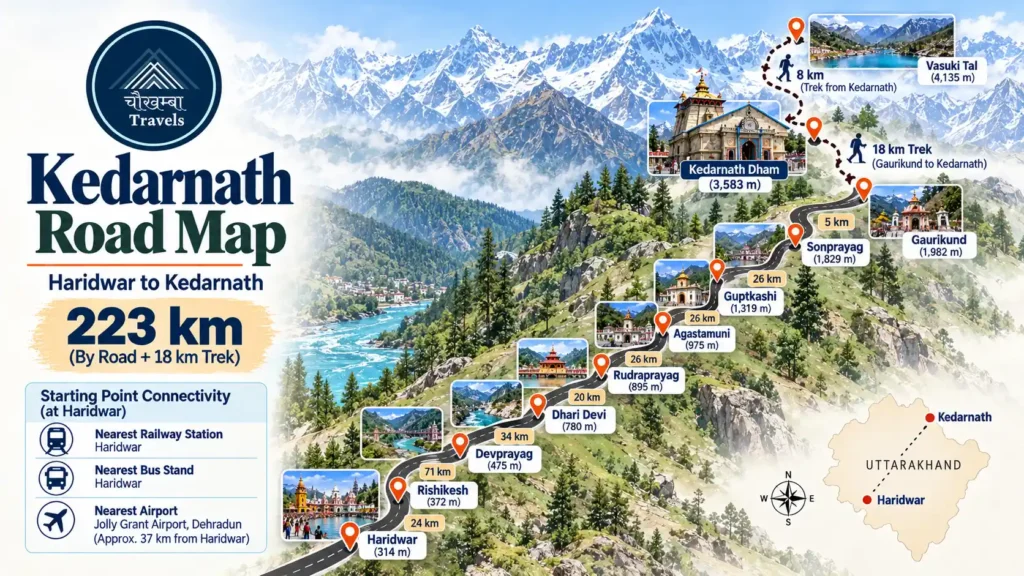
Kedarnath road map from Haridwar via Rishikesh, Devprayag, Rudraprayag, Guptkashi, Sonprayag and Gaurikund with 18 km trek to Kedarnath Dham

Package Inclusions

Package Exclusions

Places Covered During the Kedarnath Yatra

Frequently Asked Questions

Chaukhamba Travels’ Kedarnath tour packages start from ₹8,999 per person, with the final cost depending on your starting city, travel dates, group size, hotel category, vehicle type and whether a helicopter leg is included. Share your travel details for an exact quotation tailored to your trip.

A 3-night, 4-day itinerary from Haridwar or Rishikesh is the most common plan and covers the road journey, the trek, darshan and the return comfortably. Travellers wanting a slower pace, and those starting from Delhi, typically need 5–6 days. If you’re combining Kedarnath with the other three shrines, see our Char Dham Yatra Package 2026 for a full-circuit itinerary.

The Gaurikund-to-Kedarnath trek covers 16–18 km and gains roughly 1,600 metres in elevation, usually taking 6–8 hours for a moderately fit adult. It’s a well-marked, paved mountain trail — manageable for most people, but the altitude gain is the real challenge, not just the distance.

Yes, most first-time trekkers complete it successfully by starting at first light, walking at a steady pace, and using the marked rest points at Jungle Chatti, Bheembali and Linchauli. Prior trekking experience helps less than pacing and an early start.

Yes — many senior pilgrims complete the Yatra each year, often choosing a pony, palki (palanquin) or helicopter instead of walking the full 16–18 km trek. Anyone with a cardiac, respiratory or blood-pressure condition should get a doctor’s opinion before travelling, since altitude and exertion together are the main risk factors.

Yes — registration is mandatory for every pilgrim visiting Kedarnath in 2026, regardless of age or mode of travel (trek, pony, palki or helicopter). It’s completely free and done through the official Uttarakhand government portal, registrationandtouristcare.uk.gov.in.

Register online at the official Uttarakhand Tourist Care portal using your mobile number and OTP, upload a valid photo ID, choose your travel date, and download your QR-coded registration letter. Offline registration counters are also available at Haridwar, Rishikesh and Sonprayag for travellers without internet access.

Yes — helicopter shuttle services operate from the Sirsi, Phata and Guptkashi helipads, and pony or palki (palanquin) services are available from Gaurikund, as alternatives to walking the full 16–18 km trek.

Complete your Char Dham Yatra registration first to get a Yatra Registration Number, then book on the official IRCTC HeliYatra portal using that number — the portal will not accept a booking without a valid registration. No third-party website or agent is authorised to sell these tickets.

Only if the agent is booking through the official IRCTC HeliYatra portal on your behalf and shares the confirmed ticket directly from that system — Uttarakhand police have repeatedly warned about fake helicopter booking websites and social media pages during peak season. The only official channel is heliyatra.irctc.co.in.

Both work equally well and follow the same onward route to Kedarnath; Rishikesh sits about 24 km further along the road than Haridwar, saving roughly 45 minutes on Day 1. Haridwar is generally more convenient for travellers arriving by train. Road conditions on this stretch can add real delay in peak season — see our guide on avoiding traffic jams during the Chardham Yatra before you finalise your start date.

Most pilgrims overnight at Guptkashi, which has the widest range of hotels and guesthouses on the route, before and after the trek. Sonprayag and Sitapur, closer to Gaurikund, are also common but have fewer stay options; accommodation right at Kedarnath itself is very limited and should never be assumed without confirmation.

May–June and September–October are generally considered the most reliable windows, with stable weather and safer trail conditions. July–August (monsoon) carries a higher risk of landslides on the road and is usually best avoided unless your schedule allows flexibility. For a month-by-month breakdown across all four dhams, see our Best Time to Visit Char Dham Yatra 2026 guide.

Kedarnath is approximately 16–18 km from Gaurikund, which is the last point reachable by road. The remaining distance is covered on foot, by pony, palki, or helicopter from the nearby helipads.

The road distance from Haridwar to Gaurikund is approximately 230–250 km, typically taking 8–10 hours by vehicle, followed by the 16–18 km trek (or alternative) from Gaurikund to Kedarnath.

Mobile signal is reasonably reliable up to Guptkashi and Sonprayag but becomes unreliable or absent for long stretches beyond that, including most of the trek itself. Inform someone of your plans and expected timings before you’re likely to lose signal.

Essentials include warm layered clothing, a waterproof jacket, broken-in walking shoes, your printed and digital Yatra registration letter, a valid photo ID, personal medicines, a power bank, and water and snacks for the trek — food and charging points become unreliable past Guptkashi.

Daytime temperatures typically range from 8–20°C depending on the month, dropping close to or below 0°C at night, especially in the shoulder months near opening and closing. Weather can change quickly, so check a current forecast just before departure rather than relying on seasonal averages alone.

The temple typically opens in the last week of April and closes around Bhai Dooj in early-to-mid November, with exact dates announced each year by the Badri-Kedar Temple Committee in March. Kedarnath is one of the four shrines of the Char Dham Yatra and shares this seasonal opening pattern with Badrinath.

Yes — Chaukhamba Travels adjusts pickup city, travel dates, trip duration, hotel category, vehicle type and pace before booking to suit your group, budget and comfort level. See our Customized Trips page, or explore the Do Dham Yatra Package if you’d like to pair Kedarnath with Badrinath in one trip.

Chaukhamba Travels is a Dehradun-based travel operator offering customized Kedarnath Yatra packages starting from ₹18,999 per person, with pickup options from Haridwar, Rishikesh, Dehradun and Delhi, and support coordinated locally in Uttarakhand rather than through a distant call centre.

YOUR JOURNEY STARTS HERE

Your Kedarnath
Yatra, your way.

A sacred destination. A journey planned around you. Take the first step towards your Kedarnath Yatra with a personalised travel plan.

Chaukhamba Travels

Let’s plan your yatra.

Tell us your travel dates, group size and pickup city to get started.

Talk to Chaukhamba Travels +91 92598 27824