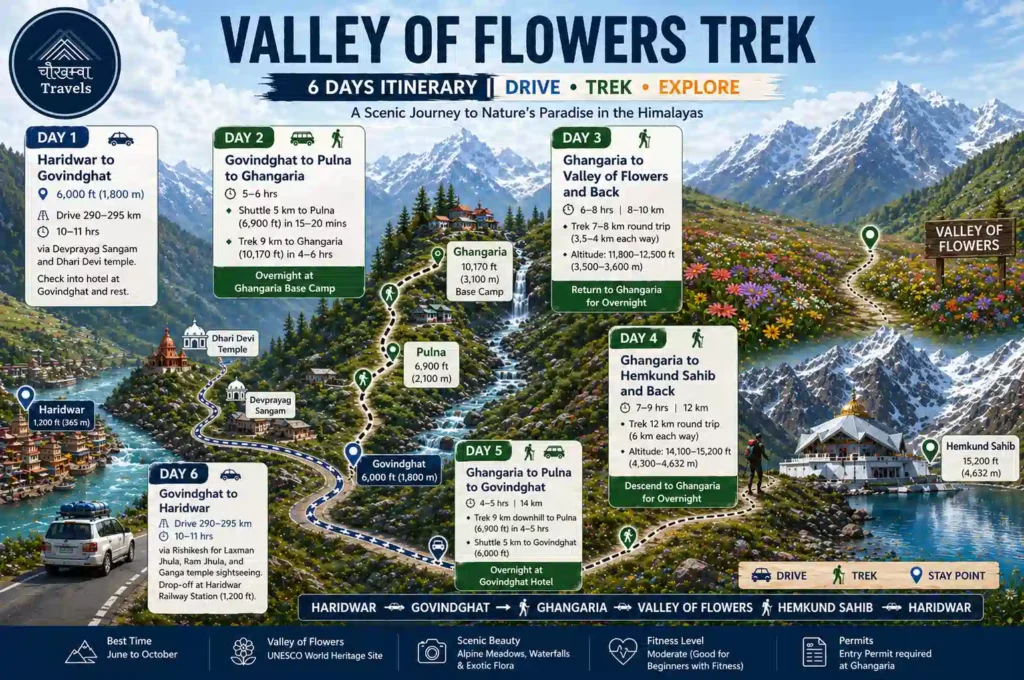
Complete route guide from Delhi, Rishikesh & Dehradun to Valley of Flowers — distances, costs, train options, road halts, and helicopter booking
Published: April 2026 | Reading time: ~8 minutes | Cluster: Planning & LogisticsValley of Flowers has no railway station, no airport, and no road beyond Govindghat. Getting there requires combining at least two modes of transport — and then a 10 km trek on foot.
That sounds complicated until you see it mapped out properly. This guide breaks the entire journey into clear segments from Delhi and Rishikesh — with current distances, realistic travel times, costs, and the one decision that most trekkers get wrong: where to break the journey overnight.
One upfront truth most guides skip: the road from Rishikesh to Govindghat takes 9–11 hours in good conditions. In July–August monsoon, landslides can add 2–4 hours or close the road entirely. Any itinerary that does not account for this is setting you up for a missed trek day.
| Journey in one line Delhi (train or bus, 5–6 hrs) → Haridwar/Rishikesh (road, 5–6 hrs)→ Joshimath (road, 45 min)→ Govindghat (shared jeep, 15 min)→ Pulna (trek, 4–6 hrs) → Ghangaria (trek, 1 hour) → Valley of Flowers. Total: 2 travel days minimum from Delhi. |
Distance overview — where you are starting from
Valley of Flowers has no single gateway — travellers approach from Delhi, Dehradun, Haridwar, or Rishikesh. The endpoint is always the same: Govindghat, the last motorable village, from where the trek begins.
| Starting point | Distance to Govindghat | Drive time | Recommended halt |
| Delhi | ~500 km | 12–14 hrs | Rishikesh or Joshimath |
| Rishikesh | ~272 km | 8–10 hrs | Joshimath |
| Haridwar | ~295 km | 10–11 hrs | Joshimath |
| Dehradun | ~303 km | 9–11 hrs | Joshimath |
| Jolly Grant Airport | ~293 km | 10–11 hrs | Joshimath |
| The monsoon road reality The NH7 stretch from Rishikesh to Govindghat passes through active landslide zones, especially between Rudraprayag and Joshimath. In July–August, road closures of 2–8 hours are common. The Uttarakhand government runs a road condition helpline: 1800-180-4145. Always check conditions before departure. Build a buffer day into your itinerary — not a suggestion, a practical necessity. |
All transport options compared — costs and honest trade-offs
| Mode | Cost (Delhi base) | Time | Best for | Verdict |
| Train to Haridwar + taxi | ₹500–1,500 + ₹8,000–12,000 | 14–16 hrs total | Budget groups (4+) | Best value |
| Volvo bus to Rishikesh + taxi | ₹800–1,200 + ₹8,000–12,000 | 15–17 hrs total | Solo / couples | Good budget |
| Direct private taxi | ₹14,000–20,000 (full cab) | 12–13 hrs | Groups wanting comfort | Recommended |
| Flight (Delhi–Dehradun) + taxi | ₹4,500–8,500 + ₹10,000–14,000 | 5–6 hrs total | Time-short travellers | Premium option |
| Helicopter (Govindghat–Ghangaria) | ₹10,080 round trip/person | 8–10 min flight | Elderly / mobility issues | Book via IRCTC |
A few honest points the table cannot capture:
- Direct taxi (Delhi–Govindghat in one stretch): Technically possible but genuinely miserable. 520 km of mountain road in one day means arriving exhausted at the base of a 10 km trek. Do not do this.
- Shared cabs from Rishikesh: Available but unpredictable. They depart only when full (6–8 passengers). In peak season this is fine. In June or September, you may wait hours.
- Private taxi group split: A private cab from Rishikesh to Govindghat costs ₹8,000–12,000 for the vehicle. Split among 4–5 people, it is often cheaper than Indiahikes-style package transport and gives you full schedule control.
Getting to Rishikesh or Haridwar by train — best options from Delhi
Train is the most practical first leg from Delhi. Rishikesh railway station (Yog Nagari Rishikesh) is the nearest major station to the trek route at 272 km from Govindghat. Haridwar is slightly closer to Delhi and has more frequent trains.
| Train name | Route | Departs Delhi | Arrives | Type |
| Shatabdi Express (12017) | Delhi → Haridwar | 06:45 | ~11:55 | Chair Car |
| Jan Shatabdi (12055) | Delhi → Dehradun | 15:20 | ~21:55 | Chair Car |
| Mussoorie Express (14041) | Delhi → Dehradun | 22:35 | ~07:00+ | Sleeper/AC |
| Nanda Devi Express (12205) | Delhi → Haridwar | 23:55 | ~05:15+ | Sleeper/AC |
| Vande Bharat(22457) | Delhi → Dehradun | 17:50 | ~22:35 | Chair Car |
Booking note: Train reservations fill up 30–60 days ahead in peak season (July–August). Book on IRCTC as early as possible. If you cannot get a reserved seat, Tatkal quota opens 1 day before departure — expensive but available.
| Best train strategy Take an overnight train from Delhi to Haridwar or Dehradun (Mussoorie Express, Nanda Devi Express, or Doon Express). You arrive early morning, have breakfast, and proceed directly to Joshimath by cab or bus — reaching Govindghat the same evening. This saves one full night of hotel cost in Delhi and puts you on schedule without rushing. |
Coming by flight — Delhi to Dehradun
If you are short on time or travelling from a non-Delhi city, flying to Jolly Grant Airport in Dehradun is the fastest option to reach the region.
- Airport: Jolly Grant Airport (Dehradun) — ~303 km from Govindghat.
- Flight time: 50–60 minutes from Delhi. IndiGo and Air India operate daily flights.
- Fare range: ₹4,500–₹8,500 per person one-way (varies significantly by booking lead time).
- Airport to Govindghat: Taxi from the airport. Fare: ₹10,000–₹14,000 for a full cab (not per person). Share among 4+ people. Travel time: ~10–11 hours with a Joshimath halt.
Honest assessment: flying saves roughly 4–5 hours compared to the overnight train route. Given the overall 2-day journey from Delhi regardless, this time saving rarely justifies the cost premium for budget-conscious trekkers — unless you are travelling from another Indian city where a direct Dehradun flight makes strong sense.
The full route, segment by segment — what to expect on each stretch
This is the section most guides write in one paragraph. It deserves detail because the road from Rishikesh to Govindghat is not a highway drive — it is a mountain road along the Alaknanda river with its own character, hazards, and highlights.
| # | Segment | Distance | Time | Notes |
| 1 | Delhi → Haridwar | ~200 km | 4–5 hrs | NH58 / NH334. Train recommended. Overnight bus also works. |
| 2 | Haridwar → Rishikesh | ~25 km | 45 min | Cab or shared auto. Many trekkers overnight here. |
| 3 | Rishikesh → Devprayag | ~70 km | 2 hrs | NH7 river road — beautiful but slow. Worth a stop. |
| 4 | Devprayag → Rudraprayag | ~75 km | 2 hrs | Passes Srinagar (Garhwal). Lunch stop option. |
| 5 | Rudraprayag → Joshimath | ~125 km | 3–4 hrs | Karnaprayag, Chamoli en route. Last big town before trek. |
| 6 | Joshimath → Govindghat | ~22 km | 45 min | Road ends here. Parking available. Overnight recommended. |
| 7 | Govindghat → Pulna | ~4 km | 15 min | Shared jeep/union taxi only. Private vehicles not allowed. |
| 8 | Pulna → Ghangaria (trek) | ~13 km | 4–6 hrs | Trek only. Ponies/porter available. No vehicles permitted. |
| 9 | Ghangaria → Valley entrance | ~3 km | 30 min | On foot only. Permit checkpoint here. Ponies not allowed inside. |
The five confluences — why the drive is worth attention
The route from Rishikesh to Govindghat passes through five sacred river confluences — called Panch Prayag — where major Himalayan rivers merge. These are not tourist traps. They are genuinely beautiful and provide natural stopping points on an otherwise long drive.
- Devprayag: Bhagirathi + Alaknanda → forms the Ganga. The most dramatic visually.
- Rudraprayag: Mandakini + Alaknanda. Good lunch stop options.
- Karnaprayag: Pindar + Alaknanda.
- Nandaprayag: Nandakini + Alaknanda.
- Vishnuprayag: Dhauliganga + Alaknanda. Just before Joshimath.
Budget 10–15 minutes per prayag if you want a proper look. None require major detours from the main road.
Why Joshimath overnight is non-negotiable — not optional
Every fast-track itinerary that tries to skip Joshimath and push straight to Govindghat the same day ends the same way: trekkers arrive at Govindghat in darkness, exhausted, and then attempt the 10 km Pulna–Ghangaria trek on zero rest the next morning. By the time they reach the valley, they are too tired to enjoy it.
Joshimath sits at 1,875 metres. Spending one night there serves two purposes: rest, and the beginning of altitude acclimatisation before you climb to Ghangaria at 3,000 metres. For anyone prone to altitude sickness, this night is genuinely important physiologically — not just logistically.
- ATMs: Joshimath has the last reliable ATMs before Govindghat. Withdraw enough cash for your entire trek — there are no ATMs at Ghangaria or beyond.
- Shops: Last place to buy any forgotten gear — warm layers, rain gear, trekking poles, basic medication.
- Food: Multiple good dhabas and restaurants. Eat well — Ghangaria’s food options are limited.
- Mobile network: Last reliable 4G connectivity. Download offline maps, confirm bookings, and inform contacts of your schedule here.
| Govindghat parking — do not assume space Govindghat has limited parking. During peak season (July–August), the parking lot fills by morning. If you are driving a private vehicle, arrive by 6:00 AM or arrange to park at Joshimath and take a shared taxi (30–45 minutes, ~₹100 per person) to Govindghat. Alternatively, most operators include transport management in their packages. |
Govindghat to Ghangaria — the 10 km you need to plan properly
The road ends at Govindghat. From here, the only options to reach Ghangaria are trekking, ponies, or helicopter. No vehicles — not even shared jeeps — go beyond Pulna village (4 km from Govindghat).
Option 1: Trek (recommended for able-bodied trekkers)
Distance: ~10 km from Pulna to Ghangaria. Elevation gain: ~800 metres. Time: 4–6 hours at a comfortable pace.
The trail is well-maintained stone path for most of its length. It follows the Lakshman Ganga river through forest and small settlements. It is not technical — but it is long, and in July–August the trail is wet and can be slippery. Trekking poles are strongly recommended.
Start time: Leave Pulna by 7:00–8:00 AM at the latest. The earlier you start, the more time you have in Ghangaria before afternoon rain.
Option 2: Ponies and palanquins
- Ponies: Available from Pulna to Ghangaria. Cost: ₹800–1,500 depending on season and demand. Useful for those with knee issues or carrying heavy loads. Book at the Pulna stand on arrival.
- Palanquin (Palki/Doli): Available for those unable to walk. Carried by 4 porters. Cost: ₹3,000–₹5,000 one way. Must be arranged in advance during peak season.
- Porters: ₹500–₹800 to carry your backpack. Strongly recommended if your pack exceeds 8 kg — the 10 km trek with heavy gear is where most injuries happen.
Option 3: Helicopter (Govindghat to Ghangaria)
For elderly visitors, those with mobility issues, or anyone short on time, helicopter service operates between Govindghat helipad and Ghangaria helipad.
- Flight time: 8–10 minutes.
- Fare (2025 confirmed rate): ₹10,080 per person round trip. This is the government-fixed rate via Pawan Hans, booked through the official IRCTC Heli Yatra portal: heliyatra.irctc.co.in.
- Booking: Online only via IRCTC. Registration mandatory before booking. Do not book through third-party agents.
- Critical caveat: Helicopter service in July–August is highly weather-dependent. During monsoon, flights are frequently cancelled with no advance notice. Do not plan a tight itinerary around helicopter availability in peak season. Always have the trek as your backup plan.
| Helicopter fraud warning Multiple fake booking websites and WhatsApp agents claim to sell Valley of Flowers / Hemkund helicopter tickets at discounted rates. The only legitimate booking platform is heliyatra.irctc.co.in. Pawan Hans is the official operator. Any person or website asking for advance payment outside this portal is a scam. IRCTC helpline: 1800-110-139. |
Recommended day-wise journey plan from Delhi
This is the itinerary structure that experienced trekkers consistently use. Not the fastest possible — the one that actually works.
| Day | Route | Overnight halt | Why this halt |
| Day 1 | Delhi → Rishikesh (train/bus) | Rishikesh | Acclimatise. Last ATM before hills. |
| Day 2 | Rishikesh → Joshimath (taxi/bus) | Joshimath | Altitude adjustment at 1,875m. Last decent shops. |
| Day 3 | Joshimath → Govindghat → Ghangaria (trek) | Ghangaria | Base for valley. Book permit here. |
| Day 4 | Valley of Flowers day | Ghangaria | Enter 7AM, exit by 1:30PM. |
| Day 5 (opt) | Hemkund Sahib | Ghangaria | Early start — steep climb. |
| Day 6 | Ghangaria → Govindghat → Rishikesh | Rishikesh or drive home | Flexible return. |
| The one scheduling mistake that ruins VOF trips Trying to do Delhi → Govindghat → Ghangaria in 2 days (Day 1 Delhi to Rishikesh, Day 2 Rishikesh to Ghangaria). The Rishikesh–Govindghat drive alone is 9–11 hours. Add the 10 km Pulna–Ghangaria trek and you are asking people to do 13–15 hours of travel and trekking in a single day. You arrive at Ghangaria at 8–9 PM, too dark and exhausted to do anything. Day 3 then becomes a recovery day, not a valley day. Add Joshimath as a halt on Day 2. It costs one extra night. It saves the whole trip. |
Coming from cities other than Delhi
From Mumbai or Bangalore
Fly to Dehradun (Jolly Grant Airport). Direct flights operate from both cities. From the airport, follow the Dehradun → Joshimath → Govindghat road route. Total time from landing to Govindghat: 10–12 hours including the drive.
From Chandigarh
Drive or take a bus to Rishikesh (~240 km, 5–6 hours). From Rishikesh, follow the standard route. This is a clean, straightforward approach that avoids Delhi entirely.
From Haridwar (arriving by train)
Haridwar to Govindghat is approximately 295 km and 10–11 hours by road. Start by 5:30–6:00 AM from Haridwar for a comfortable arrival at Joshimath by evening. Shared cabs leave from Haridwar ISBT to Joshimath during season.
Frequently asked questions
Can I take a direct bus from Delhi to Govindghat?
There is no direct bus. The closest you can get by public transport is Joshimath via Uttarakhand Roadways buses from Rishikesh. From Joshimath, shared jeeps operate to Govindghat. The full public transport journey takes 2 days minimum.
Is the road to Govindghat safe during monsoon?
Generally yes, but with caveats. The route passes through active landslide zones, particularly between Rudraprayag and Joshimath. Minor landslides causing 2–6 hour delays are common in July–August. Major blockages requiring overnight waits are less frequent but do occur. Check Uttarakhand road conditions at 1800-180-4145 before departure.
Can I reach Ghangaria without trekking?
Yes, via helicopter (weather permitting) or pony/palki. However, ponies are not allowed inside the Valley of Flowers national park — you must walk the final section from the checkpoint regardless. The helicopter is the only complete non-trekking option for Govindghat to Ghangaria.
Is there any transport from Ghangaria to the Valley entrance?
No. The 1.5 km section from Ghangaria market to the Forest Department checkpoint, and the 3.5 km from checkpoint into the valley, is foot-only. No ponies, no vehicles, no exceptions. This is a conservation rule, not a guideline.
What is the nearest railway station to Valley of Flowers?
Rishikesh (Yog Nagari Rishikesh station) at approximately 272 km from Govindghat. Haridwar is at approximately 280 km and has more frequent train services from major cities. Both are valid starting points — Rishikesh is marginally closer; Haridwar has better train connectivity.
| Plan your Valley of Flowers trip with us → Best Time to Visit Valley of Flowers 2026 — which weeks to book → Permits & Entry Guide 2026 — fees, online process, timings → Complete Packing List — what to carry and what to leave behind →View our 2026 guided packages — transport, permits, accommodation included |