Exact fees, step-by-step process, camera rules, drone policy — everything verified for the 2026 season
Published: April 2026 | Reading time: ~7 minutes | Cluster: Planning & Logistics
Getting a permit for Valley of Flowers is not complicated. But it is mandatory, and getting it wrong — wrong fee, missing ID, no advance booking in peak season — costs you real time at the gate when you should be in the valley.
This guide gives you every current detail: the full fee structure for Indians and foreigners, the step-by-step online booking process, camera and drone rules, timings, and a pre-trek checklist so nothing gets missed.
One honest note upfront: permit fees have been revised at least once in recent seasons without advance public notice. The figures in this guide are cross-verified from multiple sources as of April 2026, but you should always confirm the current rate at the official Forest Department portal or with your trek operator before travel.
| Key facts at a glance Park opens: June 1, 2026 | Closes: ~October 4, 2026 | Entry hours: 7:00 AM – 2:00 PM (last entry) | Exit by: 5:00 PM | Overnight stays: Strictly prohibited inside the valley | Permit counter: Ghangaria village (1.5 km before valley entrance) | Online booking: Available via Uttarakhand Forest Department portal |
Is a permit actually mandatory for the Valley of Flowers?
Yes, without exception. Valley of Flowers is a protected national park under the Wildlife Protection Act and a UNESCO World Heritage Site. Every visitor — Indian or foreign, solo trekker or tour group, pilgrim or photographer — must carry a valid entry permit.
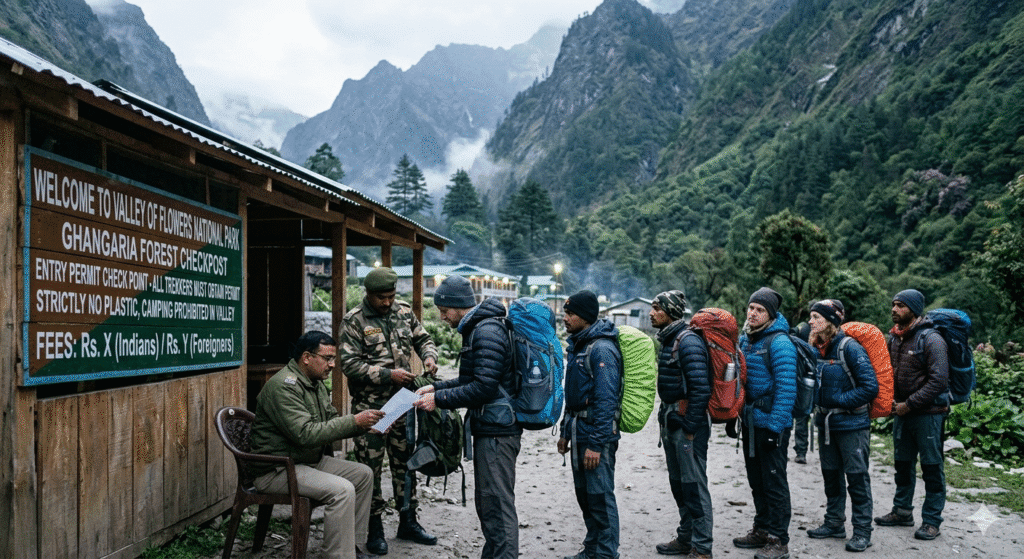
There is no free entry, no exemption for children above 12, and no grace period. Forest officials check permits at the checkpoint approximately 1.5 km from the Ghangaria market, before the actual valley entrance. Attempting to enter without one will get you turned back, no matter how far you have already trekked.
Important: As of June 2025, online registration was made compulsory by the Uttarakhand Forest Department. Whether this continues as a strict requirement or operates alongside walk-in permits for 2026 should be verified on the official portal before your visit, as enforcement can vary by season.
Complete fee structure 2026
This is where most guides give you a single number and move on. The reality is more nuanced — fees differ by nationality, age, student status, and length of stay. Here is the full breakdown:
| Visitor category | 3-day base pass | Each additional day |
| Indian adult | ₹150 – ₹200* | ₹50 |
| Indian student (18+) | ₹100 | ₹50 |
| Indian student (12–18) | ₹50 | ₹50 |
| Children under 12 | FREE | Free |
| Senior citizen (60+) | Discounted* | — |
| Physically handicapped | Discounted* | — |
| Foreign national | ₹600 – ₹800* | ₹250 |
| Fee discrepancy — read before you go Multiple credible sources currently cite conflicting base fees for Indian adults: some state ₹150 for a 3-day pass, others ₹200. A 2025 news report from ETV Bharat (dated May 17, 2025) citing the DFO directly stated ₹200 for Indians and ₹800 for foreigners — suggesting a fee revision was implemented that season. Always verify the current rate at the official portal (uttarakhandforest.gov.in) or with the Ghangaria counter before travel. Budget ₹300 per person to be safe. |
A few additional fee points that most guides do not mention:
- Students (18+): Reduced rate available with a valid government institution ID card. Carry the original — photocopies are not accepted.
- Senior citizens (60+): Discounted entry with age proof (Aadhaar, birth certificate, or any government-issued document showing date of birth).
- Physically handicapped visitors: Discounted entry with a certificate from a Medical Officer or Social Welfare Department.
- Children under 12: No fee. However, they must still be registered at the checkpoint.
- Government Central employees: Special Casual Leave provisions apply — check with your employer for current rules.
Camera, drone, and filming fees — what nobody tells first-timers
Bringing a camera into Valley of Flowers is not automatically free. There is a separate fee structure for photography and filming equipment. This catches a lot of trekkers off guard at the gate.
| Equipment type | Fee / approval required |
| Personal camera / DSLR | Small fee at gate counter (verify on arrival) |
| Video camera | Fee at gate counter |
| Drone | Prior permission from PCCF Wildlife, Dehradun — NOT available at gate |
| Feature film / documentary | Prior permission from PCCF Wildlife — contact dcfndnp-forest-uk@nic.in |
| Do NOT arrive with a drone without prior permission Drone use inside Valley of Flowers National Park requires written permission from the Principal Chief Conservator of Forests (Wildlife) / Chief Wildlife Warden of Uttarakhand. Address: 85, Rajpur Road, Dehradun. Tel: 0135-2746691. Email: cwlwua@yahoo.co.in. This is NOT available at the gate counter. If you arrive with an undeclared drone, it will be confiscated. Apply at minimum 3–4 weeks before your visit. |
How to get your permit online — step by step
Online booking is the strongly recommended route, especially for July–August visits. During peak season, the offline queue at Ghangaria can run 30–60 minutes, eating into your limited morning window inside the valley.
| Step 1 | Visit the official Uttarakhand Forest Department portal for Valley of Flowers |
| Step 2 | Select ‘Valley of Flowers National Park’ and choose your visit date |
| Step 3 | Enter personal details: name, address, age, nationality, ID proof type |
| Step 4 | If carrying a camera, declare it here and pay the applicable camera fee |
| Step 5 | Complete payment online — UPI, debit/credit card, net banking accepted |
| Step 6 | Download the e-permit confirmation. Print a copy OR save on your phone |
| Step 7 | Show the permit at the Ghangaria checkpoint — officials will verify before entry |
| Pro tip: book the night before — not weeks in advance Unlike some national parks, Valley of Flowers permits do not require booking months ahead. The practical advice is to book the evening before your planned valley day while you are settled in Ghangaria. This avoids the problem of locking in a date and then having your trek delayed by weather or trail conditions. In peak season, same-day online availability may be limited — book no later than the evening before. |
Getting the permit offline — when and how
If the online portal is down, you have poor connectivity, or you are visiting in the off-peak months (June or September) when queues are thin, the offline route works fine.
- Go to: The Forest Department permit counter in Ghangaria — located near the main market, approximately 1.5 km before the valley checkpoint.
- Carry: Original government-issued ID (Aadhaar, Voter ID, PAN, or Passport for foreigners), plus cash.
- Timing: Counter opens by 6:30–7:00 AM. Arrive early in peak season — the queue builds fast as trekkers try to make the early entry.
- Payment: Cash only at the offline counter. Carry at minimum ₹300–400 per person to cover fees plus any camera charges.
| Factor | Online permit | Offline (Ghangaria gate) |
| Availability | Anytime before visit | Only on day of trek |
| Peak season risk | Secured in advance | Queue 30–60 mins in July–Aug |
| Payment | Online (UPI/card) | Cash only |
| Best for | July–August visitors | June / September visitors |
| Recommended? | YES — always safer | Only if online fails |
Entry timings and rules — the non-negotiables
These are not suggestions. They are enforced by forest officials.
- Entry opens: 7:00 AM. The gate is not accessible before this.
- Last entry allowed: 2:00 PM. If you arrive at the checkpoint after 2:00 PM, you will be turned away regardless of circumstances.
- Mandatory exit by: 5:00 PM. All visitors must have exited the park by this time.
- Overnight stay: Strictly prohibited inside the valley. The nearest accommodation is in Ghangaria.
- Recommended arrival at gate: 6:45 AM. This gives you time to queue, get the permit checked, and enter at 7:00 AM sharp — maximising your time before afternoon monsoon rain rolls in.
| Why the 2:00 PM cutoff matters more than it sounds During July and August, heavy rain typically begins in the early-to-mid afternoon. Entering the valley after 12 noon means you will be caught in the worst of it. The 2:00 PM last-entry rule exists partly for this reason. Experienced trekkers aim to be inside the valley by 7:30 AM and return to Ghangaria by 1:00–1:30 PM at the latest. Plan your accommodation departure time backward from this. |
What to carry to the permit counter — pre-trek checklist
Use this before you leave Ghangaria for the valley day:
| ✓ | Item | ✓ | Item |
| ☐ | Aadhaar / Voter ID / Passport (original) | ☐ | Downloaded e-permit OR printed copy |
| ☐ | 2 passport-size photographs (recommended) | ☐ | Cash for offline permit (₹200–₹500 minimum) |
| ☐ | ID photocopy (offline route) | ☐ | Camera declared if carrying DSLR/video |
| ☐ | Drone: separate written permission | ☐ | Student ID if claiming student rate |
| ☐ | Senior citizen age proof if claiming discount | ☐ | Government Central employee leave certificate if applicable |
Rules inside the park — what you can and cannot do
These are legally enforced. Violations can result in fines or being removed from the park.
You must not:
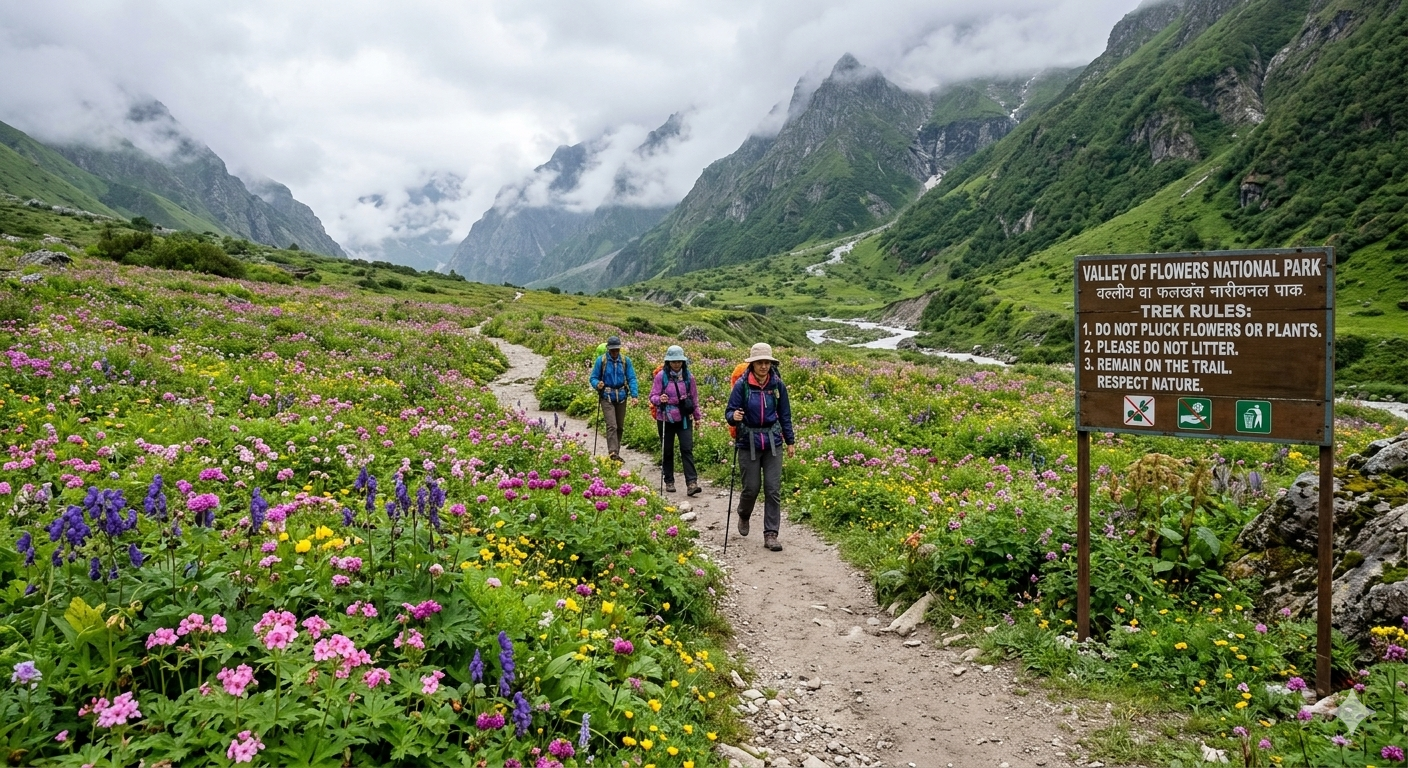
- Pluck, uproot, or damage any plant or flower — including picking up fallen blooms
- Carry or use firewood, camping stoves, or light fires
- Leave plastic, bottles, or any litter inside the park — carry all waste out
- Consume alcohol, aerated drinks, or drugs inside the park
- Play loud music without headphones
- Shoot, hunt, or disturb any wildlife
- Carry pets
- Fly a drone without prior written permission
- Camp overnight inside the park
You must:
- Carry your permit at all times and present it at any checkpoint on request
- Declare any plastic items at registration
- Follow designated trails only — off-trail walking damages the fragile ecosystem
- Begin your return by 1:30 PM to exit by 5:00 PM
Frequently asked questions
Can I get the permit on the same day as my visit?
Yes, both online (if availability exists) and offline routes are technically same-day. In practice, during peak season you should book online the evening before. Same-day availability online in July–August cannot be guaranteed.
Is the permit valid for multiple days?
The base permit covers 3 days of access. Each additional day beyond 3 is charged separately — ₹50 for Indians, ₹250 for foreigners. Most trekkers only visit the valley on one day, so the 3-day pass is sufficient.
Does the same permit cover Hemkund Sahib?
No. The Valley of Flowers permit is specific to the national park. Hemkund Sahib is accessed via a separate trail from Ghangaria and does not require the same forest permit, though some trekking operators handle a registration formality at Ghangaria for the Hemkund route. Confirm with your operator.
What ID do foreigners need?
A valid passport is mandatory. Carry the original — photocopies are not accepted at the checkpoint. Your visa documentation should also be in order for any broader travel requirements in Uttarakhand.
Is there a group discount?
No group discount exists for individual tourists. Tour operators may have separate arrangements with the Forest Department for organised groups — ask your operator specifically when booking a package.
What happens if I lose my permit inside the valley?
You would need to show proof of payment. If you booked online, the digital copy on your phone serves as backup. This is another reason to screenshot or save your permit confirmation before leaving Ghangaria, where connectivity is available.
| Sorted your permit? Now plan the rest of your trip. → Best Time to Visit Valley of Flowers 2026 — exact bloom windows by week → Complete Packing List — what most lists get wrong → How to Reach Valley of Flowers from Delhi and Rishikesh → View our guided Valley of Flowers packages for 2026 |