
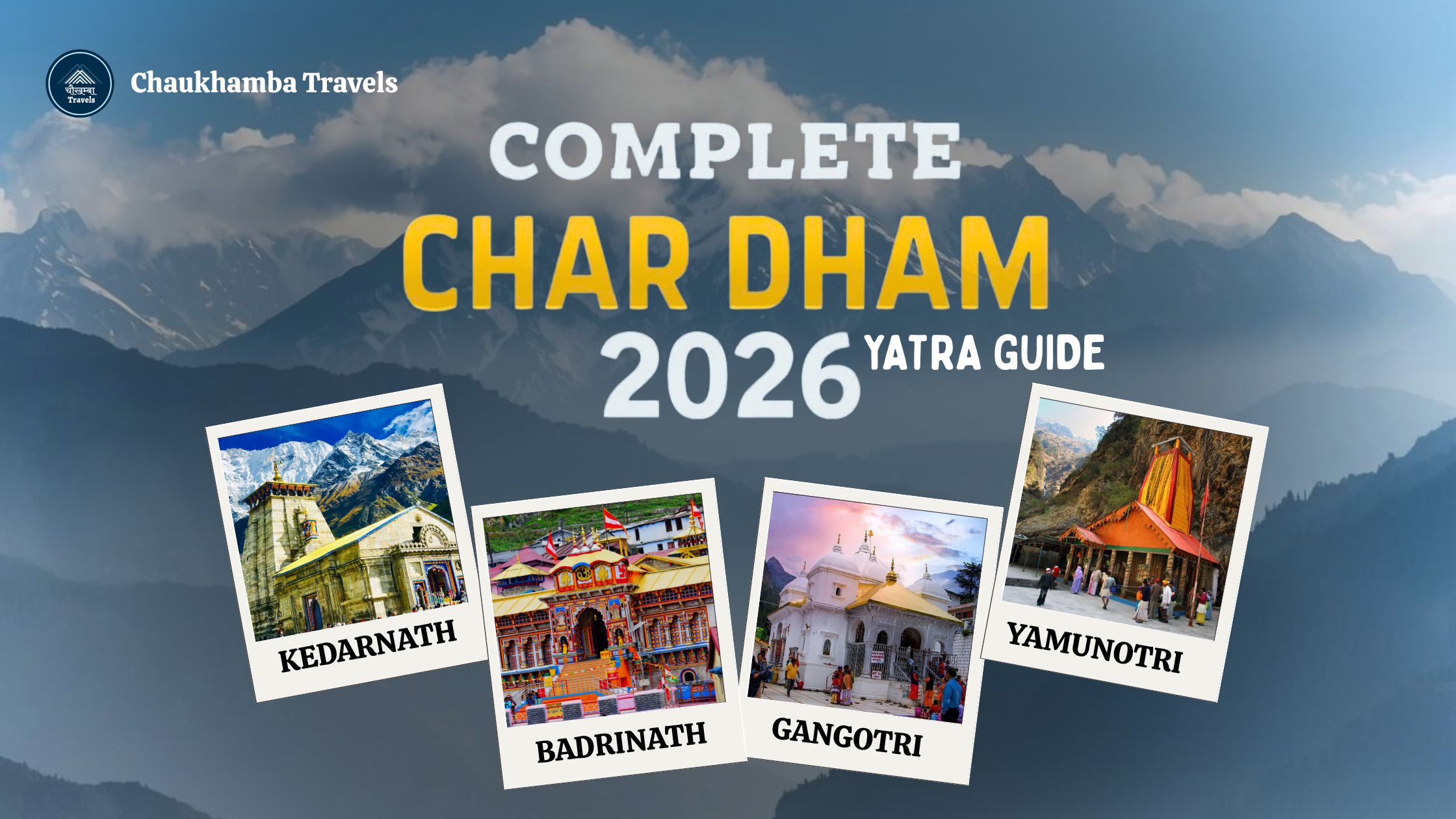
Every year, millions of devout Hindus set out on one of the most sacred and demanding journeys in the world — the Char Dham Yatra. Climbing through mist-covered Himalayan passes, crossing sacred rivers, and standing before four ancient temples tucked high in the Garhwal Himalayas, this pilgrimage is not merely travel — it is a pursuit of moksha, spiritual liberation. In 2026, the temples open from April 19 onward, giving you a six-month window to explore Char Dham Yatra packages 2026. This complete Char Dham Yatra Guide 2026 covers everything: registration, routes, itineraries, costs, packing essentials, and tips to make your pilgrimage safe, meaningful, and unforgettable.
🙏 Key Takeaways: Char Dham Yatra 2026 at a Glance
| 📅 Temple Opening Dates | Yamunotri & Gangotri: Apr 19 | Kedarnath: Apr 22 | Badrinath: Apr 23 |
| 📋 Registration | Free & mandatory at registrationandtouristcare.uk.gov.in |
| 🗺️ Traditional Route | Yamunotri → Gangotri → Kedarnath → Badrinath (clockwise) |
| ⏱️ Duration | 10–12 days (road) | 5–7 days (helicopter) |
| 💰 Cost Range | ₹22,000–₹35,000 (budget) | ₹45,000–₹70,000 (standard) | ₹1,20,000+ (premium) |
| 🌤️ Best Time to Visit | May–June (peak) or Sep–Oct (off-peak, fewer crowds) |
Table of Contents
- Understanding Char Dham Yatra 2026
- Char Dham Opening Dates & Temple Schedule 2026
- Char Dham Yatra Route Map
- Distance Between Char Dham Temples
- Char Dham Yatra Registration: Complete Guide
- Sample 10–12 Day Char Dham Yatra Itinerary
- Char Dham Yatra Cost Breakdown
- Helicopter vs Road Char Dham Yatra
- Important Travel Tips for Char Dham Yatra
- Weather & Best Time to Visit
- Frequently Asked Questions
Understanding Char Dham Yatra 2026: Basics Every Pilgrim Should Know
What is Char Dham Yatra?
The Char Dham Yatra refers to a sacred Hindu pilgrimage covering four temples in Uttarakhand: Yamunotri, Gangotri, Kedarnath, and Badrinath. This circuit is also known as Chota Char Dham, distinct from the original Char Dham established by Adi Shankaracharya spanning four corners of India.
The Uttarakhand pilgrimage takes you through the Garhwal Himalayas, where devotees believe the journey washes away sins and opens the path toward spiritual liberation. The circuit is traditionally completed in a clockwise direction — Yamunotri → Gangotri → Kedarnath → Badrinath. Some pilgrims opt for the shorter Do Dham Yatra covering only Kedarnath and Badrinath.
The Four Sacred Temples: Overview
- Yamunotri (3,293 m | Uttarkashi): Dedicated to Goddess Yamuna. Natural hot springs of Surya Kund allow pilgrims to offer rice and potatoes cooked in the sacred waters. Bathing here is believed to protect from untimely death.
- Gangotri (3,100 m | Uttarkashi): Dedicated to Goddess Ganga. Hindu legend holds that King Bhagirath’s penance brought the Ganges to earth here. You can also trek to Gaumukh glacier — the river’s true source.
- Kedarnath (3,583 m | Rudraprayag): One of the 12 Jyotirlingas of Lord Shiva. This 12th-century stone temple sits on the Mandakini River banks. A 16 km trek from Gaurikund makes it the most physically demanding dham. Touching the Kedarnath lingam is believed to cleanse lifetimes of karma.
- Badrinath (3,133 m | Chamoli): Dedicated to Lord Vishnu. Counted among the 108 Divya Desams and one of Adi Shankaracharya’s original Char Dhams. The Tapt Kund hot springs outside offer welcome relief from the cold.
Char Dham Opening Dates 2026 and Temple Schedule
The Char Dham Temple Committee has confirmed opening dates for 2026 using traditional Hindu Panchang calendar calculations and weather assessments. Plan your travel around these confirmed dates.
Complete Opening and Closing Dates 2026
| Temple | Opening Date 2026 | Opening Time | Closing Date 2026 | Special Occasion |
|---|---|---|---|---|
| Yamunotri | April 19, 2026 | Morning | November 11, 2026 (Tentative) | Akshaya Tritiya |
| Gangotri | April 19, 2026 | Morning | November 10, 2026 (Tentative) | Akshaya Tritiya |
| Kedarnath | April 22, 2026 | 8:00 AM | November 11, 2026 (Tentative) | Announced on Maha Shivratri |
| Badrinath | April 23, 2026 | 6:15 AM | November 13, 2026 (Tentative) | Announced on Basant Panchami |
📌 How Temple Dates Are Announced
Yamunotri & Gangotri open on Akshaya Tritiya. Kedarnath’s date is declared on Maha Shivratri (giving ~3 months’ advance notice). Badrinath’s date is announced on Basant Panchami from the royal court of Tehri Naresh in Narendra Nagar.
Closing dates are announced on Vijayadashami (Dussehra). During winter, deities relocate: Kedarnath’s idol → Omkareshwar Temple (Ukhimath) | Badrinath’s deity → Pandukeshwar | Gangotri’s deity → Mukhba Village.
Peak Season vs Off-Season: When to Visit
- May–June (Peak Season): Temperatures 10°C–20°C. Fully accessible routes, all facilities open. Expect heavy crowds, higher hotel prices (+50–100%), and long darshan queues. Best for families, first-timers, and senior citizens.
- September–October (Shoulder Season — Recommended): Temperatures 5°C–20°C. Post-monsoon clarity, fewer crowds, 50% lower accommodation rates, crystal-clear mountain views. Ideal for photographers, solo travelers, and those seeking a contemplative experience.
- July–August (Monsoon — Not Recommended): Frequent landslides and road closures make travel risky. Only for experienced mountain travelers with highly flexible itineraries.
Char Dham Yatra Route Map
Understanding the route before you travel is essential for logistics, accommodation planning, and managing your energy levels across this 1,607-kilometer circuit.
Traditional Route Order
- Yamunotri — Start of the pilgrimage, honoring the source of the Yamuna River
- Gangotri — Second stop, dedicated to the source of the holy Ganga River
- Kedarnath — Third stop, the most physically demanding dham
- Badrinath — Final stop, completing the sacred circuit
🧭 Why This Route Order?
This west-to-east clockwise sequence carries both spiritual significance and logistical practicality. It mirrors the order prescribed in Hindu scriptures and flows naturally through the Garhwal Himalayan road network — minimising backtracking. Most pilgrims begin and end their journey from Haridwar, Rishikesh, or Dehradun.
Key Route Segments
- Haridwar → Barkot: 180–192 km (gateway to Yamunotri)
- Barkot → Uttarkashi: 82–100 km (gateway to Gangotri)
- Uttarkashi → Guptkashi: 200–220 km (gateway to Kedarnath)
- Guptkashi → Badrinath: via Joshimath (completing the circuit)
- Badrinath → Haridwar: Return via Rudraprayag and Devprayag
Notable Stopovers Along the Route
- Guptkashi: Known as “Hidden Kashi,” it holds the Vishwanath Temple (mirroring Kashi Vishwanath) and Ardhnareshwar Temple. Perfect rest stop before the Kedarnath trek.
- Rudraprayag: Sacred confluence of Mandakini and Alaknanda rivers — a peaceful break between Kedarnath and Badrinath.
- Joshimath: Essential stop before Badrinath and Lord Badri’s winter residence. Home to the 1,200-year-old Narsingh Temple.
- Uttarkashi: Base camp for Gangotri visits. Home to its own Vishwanath Temple on the Bhagirathi River.
- Chopta: “Mini Switzerland of India,” 57.8 km from Guptkashi. Gateway to Tungnath Temple (world’s highest Shiva temple) via the scenic Chandrashila Trek.
- Mana Village: Just 3 km from Badrinath — the last inhabited Indian village before the Tibetan border.
Distance Between Char Dham Temples
Use this reference table to plan driving time and overnight stays between each dham. All distances are approximate and measured by road from the nearest base town.
| From | To | Distance (approx.) | Drive Time | Notes |
|---|---|---|---|---|
| Haridwar | Barkot (Yamunotri base) | 180–192 km | 6–7 hrs | Via Dehradun / Mussoorie |
| Barkot | Yamunotri Temple | 13 km trek | 4–5 hrs trek | Trek from Janki Chatti |
| Barkot | Uttarkashi (Gangotri base) | 82–100 km | 3–4 hrs | Mountain road, scenic drive |
| Uttarkashi | Gangotri Temple | 100 km | 3–4 hrs | Direct road access |
| Uttarkashi | Guptkashi (Kedarnath base) | 200–220 km | 7–8 hrs | Via Rudraprayag |
| Guptkashi | Gaurikund (trek start) | 30 km | 1–1.5 hrs | Road to Sonprayag then shared taxi |
| Gaurikund | Kedarnath Temple | 16 km trek | 5–7 hrs trek | Steep ascent, ponies/palki available |
| Guptkashi | Badrinath | 190–200 km | 6–7 hrs | Via Joshimath |
| Badrinath | Haridwar (return) | 320 km | 9–10 hrs | Via Rudraprayag and Devprayag |
| Total Circuit | Haridwar → Haridwar | ~1,607 km | 10–12 days | Complete road circuit |
Char Dham Yatra Registration 2026: Complete Guide
⚠️ Registration is Mandatory — No Entry Without It
The Uttarakhand government made Char Dham registration compulsory in 2014 after the Kedarnath floods. You cannot enter any of the four temples without a valid registration QR code. Registration is completely free and opens from March 6, 2026.
Mandatory Registration Requirements
- Registration applies to every pilgrim — children, adults, senior citizens, and foreign nationals
- Completely free for both online and offline registration
- Helicopter travelers must also register separately from their flight bookings
- A single registration covers all four dhams — specify travel dates for each destination
- You receive a registration letter with QR code — show this at every shrine checkpoint
Step-by-Step Online Registration Process
Register at registrationandtouristcare.uk.gov.in, via the Tourist Care Uttarakhand app (Google Play / App Store), WhatsApp (send “YATRA” to +91-8394833833), or call toll-free 0135-1364.
- Visit registrationandtouristcare.uk.gov.in and click Register/Login
- Enter full name, mobile number, registration type (Individual/Family/Tour Operator) and sign up
- Verify your account via OTP sent to your mobile and email
- Log in and click Add/Manage Pilgrims or Create Tour Info
- Select tour type, enter start/end dates, specify number of tourists, and add each destination with visit dates
- Add each pilgrim’s details and upload scanned ID proof (10KB–150KB, JPG/PNG)
- Submit the form — receive your unique registration number via SMS
- Download and print the registration letter with QR code (keep both digital and physical copies)
Documents Required for Registration
- Valid government-issued photo ID: Aadhaar Card, Voter ID, PAN Card, Passport, or Driving License
- Foreign pilgrims must carry their passport
- Recent passport-sized photograph (digital format)
- Active mobile number for OTP verification and emergency updates
- Emergency contact details of someone not traveling with you
Offline Registration Centers Along the Route
The Char Dham Yatra registration process opens from March 6, 2026. Centers operate 4:00 AM–9:00 PM at Haridwar (Rahi Hotel), Rishikesh (ISBT, RTO, Gurudwara), Jolly Grant Airport Dehradun, Haridwar Railway Station, and Rishikesh ISBT. Route-specific centers: Barkot (Yamunotri), Hina near Maneri (Gangotri), Sonprayag (Kedarnath), and Pandukeshwar (Badrinath).
Sample 10–12 Day Char Dham Yatra Itinerary
This day-by-day itinerary is designed for a comfortable road-based pilgrimage with proper acclimatization. The 12-day version adds buffer days for weather, rest, and sightseeing flexibility — strongly recommended for first-time pilgrims — or consider one of our best Char Dham tour packages for a fully guided experience.
| Day | Route | Key Activity | Overnight Stay |
|---|---|---|---|
| Day 1 | Arrive Haridwar / Rishikesh | Arrive, rest, Ganga Aarti at Har Ki Pauri, registration check | Haridwar / Rishikesh |
| Day 2 | Haridwar → Barkot (180–192 km) | Drive via Mussoorie, check in, acclimatize | Barkot |
| Day 3 | Barkot → Janki Chatti → Yamunotri → Barkot | Drive to Janki Chatti, 6 km trek to Yamunotri temple darshan, return | Barkot |
| Day 4 | Barkot → Uttarkashi (82–100 km) | Drive along Bhagirathi River, visit Vishwanath Temple in Uttarkashi | Uttarkashi |
| Day 5 | Uttarkashi → Gangotri → Uttarkashi | Drive to Gangotri (100 km), temple darshan, optional Gaumukh trek start, return | Uttarkashi |
| Day 6 | Uttarkashi → Guptkashi (200–220 km) | Long drive via Rudraprayag, visit Ardhnareshwar Temple in Guptkashi | Guptkashi |
| Day 7 | Guptkashi → Gaurikund → Kedarnath | Drive to Sonprayag, shared taxi to Gaurikund, begin 16 km trek to Kedarnath | Kedarnath |
| Day 8 | Kedarnath darshan → Gaurikund → Guptkashi | Early morning darshan, trek back down, drive to Guptkashi or Rudraprayag | Guptkashi / Rudraprayag |
| Day 9 | Guptkashi → Badrinath (190–200 km) | Drive via Joshimath, check in, Badrinath temple evening aarti | Badrinath |
| Day 10 | Badrinath darshan + Mana Village | Morning darshan at Badrinath, Tapt Kund dip, visit Mana Village (last village before Tibet) | Badrinath / Joshimath |
| Day 11 | Badrinath → Rudraprayag / Devprayag (220 km) | Drive back, visit Devprayag — sacred confluence of Alaknanda and Bhagirathi | Rudraprayag / Rishikesh |
| Day 12 | Return to Haridwar / Rishikesh / Dehradun | Final drive back, yatra complete | Departure |
💡 Pro Tip: Build Buffer Days Into Your Schedule
Days 11–12 can act as buffer days if weather disrupts your Kedarnath or Badrinath visit. Mountain conditions change rapidly — a flexible itinerary is not a luxury, it is a necessity on this journey.
7-Day Helicopter Itinerary Overview
- Day 1: Dehradun → Kharsali Helipad → Yamunotri darshan (5.3 km trek) → overnight Barkot
- Day 2: Barkot → Harshil → Gangotri darshan (23 km drive) → overnight Uttarkashi
- Day 3: Phata Helipad → Kedarnath darshan (15 km trek or short heli ride) → overnight Guptkashi
- Day 4: Drive to Badrinath → temple darshan (1 km walk) → overnight Badrinath
- Day 5: Badrinath → Mana Village → return to Dehradun
Char Dham Yatra Cost Breakdown 2026
Your total cost depends almost entirely on how you travel. Here is a detailed breakdown across three travel styles to help you budget accurately. You can also browse our Char Dham travel packages to find an all-inclusive option that matches your budget.
Cost by Travel Style
| Travel Style | Cost Per Person | What is Included | Best For |
|---|---|---|---|
| Budget | ₹22,000 – ₹35,000 | Shared taxis/buses, dharamshalas and budget hotels, simple vegetarian meals, walking; pony rides for Kedarnath at own expense | Solo travelers, young pilgrims, those seeking an authentic experience |
| Mid-Range / Standard | ₹45,000 – ₹70,000 | Private vehicles (shared group), comfortable 2–3 star hotels, restaurant meals, Kedarnath helicopter (if booked early) | Families, couples, first-time pilgrims wanting comfort without premium prices |
| Premium / Helicopter | ₹1,20,000 – ₹2,50,000 | Helicopter for all four dhams, luxury hotels and resorts, VIP darshan passes, dedicated guide and full ground coordination | Senior citizens, those with limited time or mobility, luxury travelers |
Detailed Cost Component Breakdown
- Accommodation: Dharamshalas ₹500–₹2,000/night | Mid-range hotels ₹2,000–₹5,000/night | Luxury ₹5,000–₹15,000/night. Peak season (May–June) adds 50–100% to rates.
- Transportation: Shared taxis (full circuit) ₹10,000–₹16,000 per person | Private sedan ₹35,000–₹45,000 | Private SUV ₹45,000–₹60,000
- Kedarnath Helicopter (one-way): ₹6,500–₹8,500 per person from Phata or Sersi helipad
- Full Helicopter Circuit: All four dhams by air — ₹2,20,000–₹3,50,000 per person, including VIP darshan, luxury accommodation, all meals, and ground coordination
- Tour Packages (road, from Haridwar): Budget ₹28,000–₹40,000 | Standard comfort ₹45,000–₹65,000 | Luxury road ₹75,000–₹1,10,000 per person
- Independent Travel Savings: DIY can save 20–35% vs. packages but requires significant planning. Budget DIY: ₹22,000–₹32,000 | Moderate DIY: ₹45,000–₹65,000
💸 Booking Tip: Beat the Peak Season Price Surge
Book accommodation at least 2–3 months ahead for May–June travel — rooms can cost 50–100% more during peak season. A room at ₹2,000 in April can jump to ₹3,500–₹4,000 in May. Always verify cancellation policies before confirming, as mountain weather frequently forces itinerary changes.
Helicopter vs Road Char Dham Yatra: Which is Right for You?
| Factor | 🚁 Helicopter Yatra | 🚗 Road Yatra |
|---|---|---|
| Duration | 5–7 days | 10–12 days |
| Cost (per person) | ₹1,20,000–₹3,50,000 | ₹22,000–₹1,10,000 |
| Physical Demand | Low — minimal trekking required | High — includes 16 km Kedarnath trek |
| Comfort Level | Very high — luxury hotels, VIP darshan | Variable — depends on budget tier |
| Spiritual Experience | Focused and efficient | Immersive — full Himalayan journey |
| Weather Dependency | High — flights cancelled in bad weather | Moderate — roads may close in monsoon |
| Best For | Senior citizens, mobility-limited pilgrims, time-constrained travelers | First-timers, families, budget travelers, those seeking the full pilgrimage experience |
| Crowd Exposure | Minimal — VIP access at temples | Higher — especially in peak season |
| Booking Lead Time | 6–9 months in advance | 2–3 months for peak season |
🚁 + 🚗 Best of Both Worlds: The Hybrid Option
Many pilgrims drive to Yamunotri, Gangotri, and Badrinath by road — and take the helicopter only for Kedarnath. This hybrid approach balances cost, immersive experience, and physical demands. Book the Kedarnath helicopter 6–9 months in advance — these are the most in-demand seats on the entire circuit.
Important Travel Tips for Char Dham Yatra 2026
Packing Essentials
- Clothing: Woolen sweaters, thermal inner layers, puffer jacket, waterproof gloves, warm socks, sturdy raincoat, compact umbrella, and trekking shoes with ankle support and good grip
- Protection: Sunscreen SPF 50+, UV-protection sunglasses, wide-brimmed hat or cap
- Documents: Original government-issued photo ID, printed registration certificate with QR code, medical fitness certificate (if 55+), emergency contact card
- Energy & Nutrition: Energy bars, dry fruits, glucose sachets, ORS packets, enough water for treks
- Electronics: Fully charged power bank, torch with spare batteries (essential — limited electricity at high altitude)
Health Precautions
- Get a pre-yatra medical check-up including blood pressure, ECG, blood sugar, and pulse oximeter reading — especially for Kedarnath and Yamunotri routes
- Senior citizens (55+) and anyone with heart or respiratory conditions must carry a fitness certificate from a registered medical practitioner
- Pack altitude sickness medication (Diamox), pain relievers, anti-diarrhoeals, antacids, antiseptic cream, and a portable pulse oximeter
- Carry a portable oxygen canister — especially for Kedarnath at 3,583 meters
- Stay hydrated and ascend slowly. Altitude-related cardiac arrests are among the most common pilgrimage fatalities above 3,000 meters
- Health screening points along the route conduct 28 types of tests including BP, sugar, and oxygen saturation checks
🏥 Senior Citizens & High-Risk Pilgrims: Please Read
Cardiac arrests above 3,000 meters are among the most common causes of pilgrimage fatalities. If you are 55+ or have heart, respiratory, or blood pressure conditions, a fitness certificate from a registered doctor is mandatory. Consider the helicopter option for Kedarnath. Carry a pulse oximeter and portable oxygen canister at all times.
Booking Tips
- Register online at registrationandtouristcare.uk.gov.in as soon as registration opens (March 6, 2026) — slots and daily limits fill quickly
- Book accommodation at least 2–3 months in advance for May–June travel. Peak season inflates rates by 50–100%
- Book Kedarnath helicopter tickets 6–9 months in advance — these are the most in-demand seats on the entire circuit
- Always check cancellation and refund policies — mountain weather frequently forces itinerary changes
- Choose properties close to temples to minimize daily travel time and costs
- If booking a tour package, compare at least 3 operators and verify inclusions vs. exclusions carefully
Emergency Contact Numbers (Save Offline)
🆘 Emergency Numbers — Save These Offline Before You Leave
⚡ Mobile networks are unreliable at high altitude — always save these numbers offline and carry a printed copy.
Char Dham Weather Guide: Temperature & Best Seasons
Weather in the Garhwal Himalayas is unpredictable and changes fast. Morning sunshine can give way to afternoon rain or hail within hours. Plan your visit around these seasonal windows for the best experience — read our dedicated guide on the best time to visit Char Dham for a detailed month-by-month breakdown.
Best Time to Visit Char Dham Yatra
🌤️ Best Time to Visit Char Dham: Season-by-Season Guide
✅ September–October — Most Recommended
Post-monsoon clarity brings the best conditions. Temperatures a comfortable 5°C–20°C, roads stabilise, skies are crystal clear for mountain views, crowds drop significantly, and accommodation rates fall by up to 50%. Ideal for photographers, solo travellers, and those seeking a peaceful, contemplative darshan. Pack warm layers — early snowfall possible near Kedarnath by late October.
👨👩👧 May–June — Best for Families & First-Timers
Peak season with temperatures of 10°C–20°C. All routes fully accessible, facilities operating at full capacity. Expect larger crowds, higher accommodation prices (+50–100%), and longer darshan queues. Best for families, senior citizens, and first-time pilgrims who prioritise accessibility and full services.
⚠️ July–August — Avoid (Monsoon Season)
Frequent landslides and road closures make travel genuinely risky. Not recommended for most pilgrims. If you must travel, build 3–4 extra buffer days, monitor road conditions daily at smartharidwar.uk.gov.in, and never travel on mountain roads after heavy overnight rain.
Temperature by Temple and Season
| Temple | Altitude | May–June Temp | Sep–Oct Temp | Notes |
|---|---|---|---|---|
| Yamunotri | 3,293 m | 5°C – 15°C | 3°C – 20°C | Cold nights year-round |
| Gangotri | 3,100 m | 6°C – 16°C | 8°C – 18°C | Glacier winds; warm layers essential |
| Kedarnath | 3,583 m | 2°C – 12°C | 5°C – 15°C | Coldest dham; snowfall possible Oct |
| Badrinath | 3,133 m | 5°C – 17°C | 8°C – 20°C | Tapt Kund hot springs offer relief |
Monsoon months (July–August) bring heavy rainfall and active landslide risk across all routes. Always check road conditions at smartharidwar.uk.gov.in and local news before traveling during this period.
Conclusion: Begin Your Char Dham Yatra 2026 Journey
The Char Dham Yatra asks everything of you — your endurance, your patience, your faith — and gives back something that cannot be measured in kilometers or rupees. When you finally stand before the Kedarnath lingam at 3,583 meters, or dip your hands in the icy waters at Gangotri’s source, you carry home more than photographs. You carry the quiet certainty of having completed something sacred.
With the right preparation — early registration, smart budgeting, honest health assessment, and a flexible mindset — your 2026 Char Dham Yatra can be not just manageable but profoundly transformative. The mountains are waiting. Book your Char Dham Yatra package and start planning today.
Frequently Asked Questions: Char Dham Yatra 2026
Q1. What is the best time to visit Char Dham in 2026?
The ideal window is late September to October — clear skies, temperatures between 5°C–20°C, far fewer crowds, stable roads, and accommodation rates up to 50% lower than peak season. May to June is also reliable for first-timers and families (10°C–20°C), though you will face larger crowds and higher prices. Avoid July to September unless you are an experienced mountain traveler prepared for landslide disruptions. For a full seasonal breakdown, see our guide on when to plan your Char Dham pilgrimage.
Q2. Is registration mandatory for Char Dham Yatra 2026?
Yes, registration is compulsory for all pilgrims regardless of age. Register for free at registrationandtouristcare.uk.gov.in, via the Tourist Care Uttarakhand app, by WhatsApp (send “YATRA” to +91-8394833833), or at offline centers. You receive a QR code registration letter to present at each checkpoint. Registration opens March 6, 2026. For the complete step-by-step process, refer to our Char Dham online registration guide.
Q3. How much does a complete Char Dham Yatra cost in 2026?
Budget travelers can complete the yatra for ₹22,000–₹35,000 per person (shared transport, dharamshalas). Mid-range pilgrims typically spend ₹45,000–₹70,000 (comfortable hotels, private vehicle). Premium helicopter packages cost ₹1,20,000–₹2,50,000+. Prices surge 50–100% in May–June peak season, so booking early saves significantly.
Q4. How many days are required to complete Char Dham Yatra?
A 7-day helicopter package covers all four dhams efficiently for time-constrained travelers. A 10-day road itinerary offers a well-paced experience with proper acclimatization. A 12-day journey is best for first-timers as it builds in buffer days for weather delays and rest. The complete road circuit covers approximately 1,607 km from Haridwar.
Q5. What documents do I need for Char Dham Yatra?
You need a valid government-issued photo ID (Aadhaar, Voter ID, PAN Card, Passport, or Driving License). Foreign pilgrims must carry their passport. Also bring your printed registration confirmation with QR code, a recent passport-sized photograph, and a medical fitness certificate if you are over 55 or have existing health conditions.
Q6. When do the Char Dham temples open in 2026?
The confirmed 2026 opening dates are: Yamunotri and Gangotri on April 19 (Akshaya Tritiya), Kedarnath on April 22 at 8:00 AM, and Badrinath on April 23 at 6:15 AM. Closing dates (tentative: November 10–13) will be officially announced on Vijayadashami (Dussehra). See the full Char Dham temple opening schedule for 2026 with all confirmed timings.
Q7. Is Char Dham Yatra safe for senior citizens?
Yes, with proper planning. Senior citizens should consider the helicopter package to avoid the physically demanding Kedarnath trek. A mandatory medical fitness certificate from a registered practitioner is required for those 55+. Choose May–June for warmer temperatures, book accommodation close to temples, carry a pulse oximeter, and pack altitude sickness medication. Health screening points along the route are available for monitoring.
Q8. What is the difference between Char Dham and Chota Char Dham?
The original Char Dham (established by Adi Shankaracharya) refers to four temples spanning India’s four corners: Badrinath (North), Dwarka (West), Puri (East), and Rameswaram (South). The Chota Char Dham (or Uttarakhand Char Dham) refers specifically to the four Himalayan shrines — Yamunotri, Gangotri, Kedarnath, and Badrinath — and is the pilgrimage most commonly undertaken today.