Written by Chaukhamba Travels Team | Last updated: 12 September 2026
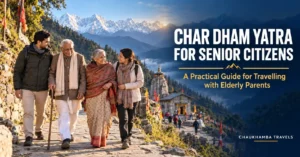
For many families, the Char Dham Yatra is not simply another holiday. It may be a journey a parent has spoken about for years—sometimes quietly, sometimes every time the family sits together. Helping them finally make that journey can be deeply rewarding. It also carries a responsibility: the route must be planned around their comfort, not around how many places can be covered in the shortest time.
Mountain roads feel longer than they look on a map. A hotel described as “near the temple” may still have a steep approach or a flight of stairs. Yamunotri and Kedarnath involve demanding routes, while Gangotri and Badrinath are approachable by road but still sit at considerable altitude. A sensible plan takes all of this into account before the booking is made.
This guide is written for families planning a Char Dham Yatra for senior citizens. It explains the effort involved at each Dham, compares road and assisted-travel options, suggests a relaxed itinerary, and lists the small hotel and transport details that can make a big difference to an elderly traveller.
How difficult is each Dham for an elderly traveller?
It is easy to speak about the Char Dham circuit as one journey, but the four temple visits are very different. Two involve substantial walking or assisted access; two are reached by road. The difficulty also comes from long driving days, cold, crowd movement and sudden changes in altitude—not only from trekking.
| Dham | Access | Effort level | Main concern for seniors | Practical approach |
|---|---|---|---|---|
| Yamunotri | Road to Janki Chatti, followed by roughly 5–6 km each way on the pilgrim trail | High | Steady climb, crowded or wet trail, and the return on the same day | Start early; consider a palki or pony if walking is not appropriate; keep the next day lighter |
| Gangotri | Road reaches the temple town; local walking remains | Medium | Long return drive from Uttarkashi and exposure to higher altitude | Use short rest stops, avoid rushing at the temple and carry warm layers in the vehicle |
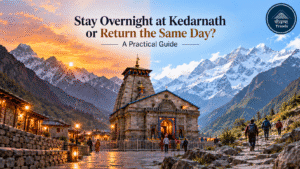
| Kedarnath | Road to Sonprayag/Gaurikund area, followed by a long mountain trail; seasonal helicopter services operate separately | Very high | Long ascent and descent, cold, rapidly changing weather and possible travel delays | Decide between trekking, palki/pony and official helicopter booking only after considering health and mobility |
| Badrinath | Road reaches Badrinath town; some walking and steps may still be involved | Lower walking | Cold, altitude, queues and fatigue accumulated over the previous days | Stay close to the temple approach, keep the day unhurried and avoid adding too much sightseeing |
A local planning point: “Road accessible” does not mean “effort free.” A traveller may still need to walk from the parking point, stand in a queue, manage steps and return to the hotel in cold weather. Ask about the complete movement from vehicle to room and from vehicle to temple—not just the highway distance.
Yamunotri needs a same-day energy plan
Families often think of Yamunotri as the “shorter trek” and underestimate the return. For a senior traveller, the descent can be tiring on the knees, and the trail may feel more difficult when it is busy. An early departure, a pre-decided assistance option and a simple evening after returning to Barkot are more useful than adding another sightseeing stop.
Kedarnath needs a backup plan
Even when a helicopter is booked, the family should be prepared for weather-related changes. Keep medicines, warm clothing, identity documents and one flexible day within the route. Helicopter travel reduces the trek; it does not remove cold, altitude, queues or operational uncertainty.
Road, assisted route or helicopter: which plan suits your parents?
The right answer depends on the traveller, not on a package label. A physically active 68-year-old may be comfortable with a relaxed road circuit, while a younger traveller with serious knee or breathing difficulty may need a very different plan. Discuss the actual route with the traveller and their doctor before choosing.
| Travel style | May suit | Main benefit | Important limitation |
|---|---|---|---|
| Relaxed road journey | Travellers comfortable with long hill drives and moderate local walking | Gradual journey with flexibility for breaks and overnight halts | Mountain driving hours remain substantial; Yamunotri and Kedarnath still need separate access decisions |
| Road + assisted access | Travellers who can handle the road circuit but should avoid long treks | Palki/pony support may reduce walking on the Yamunotri or Kedarnath trail | Availability, rates, trail conditions and comfort vary; assistance should never be treated as a guaranteed medical solution |
| Road + Kedarnath helicopter | Families seeking to avoid the long Kedarnath trek while retaining the traditional road circuit | Reduces trekking effort on the most demanding Dham | Flights are subject to weather, operational rules, passenger weight and availability |
| Helicopter circuit | Travellers prioritising shorter overall travel time and minimal road movement | Condenses the journey and avoids the major trails | Rapid altitude change, strict baggage limits, weather disruptions and higher cost must be considered |
Use official booking channels: Kedarnath helicopter tickets should be checked through the official IRCTC HeliYatra portal. Be cautious of social-media pages, unofficial payment links or anyone promising guaranteed seats outside the published process.
If your family prefers a shorter pilgrimage focused on Kedarnath and Badrinath, compare it with a Do Dham Yatra package. Completing two Dhams comfortably can be a better decision than forcing a rushed four-Dham schedule.
A practical readiness check before making the booking
No online checklist can declare a person medically fit for high-altitude travel. What it can do is help the family ask better questions. Sit down with the senior traveller and discuss the points below honestly before paying for hotels, vehicles or helicopter seats.
Health and mobility
- Has a doctor reviewed the planned high-altitude journey and current health conditions?
- Can the traveller sit comfortably through several hours of winding mountain roads?
- How far can they normally walk without unusual discomfort?
- Are stairs, uneven ground or steep descents difficult?
- Do they experience motion sickness, breathlessness, dizziness or severe fatigue?
- Will a family member or caregiver remain with them throughout the trip?
Practical preparedness
- Are prescriptions, medical history and emergency contacts available in print and on a phone?
- Are regular medicines packed with a few extra days for possible delays?
- Has the family confirmed ground-floor or lift access at every night halt?
- Is there room in the itinerary for a rest day or route change?
- Does the driver know that frequent comfort stops may be required?
- Has the family discussed what to do if one Dham must be skipped?
Medical note: This guide is for travel planning and does not replace medical advice. Anyone with an existing heart, lung, blood-pressure, diabetes, mobility or other health concern should speak with their doctor before booking. Follow current guidance published by the Uttarakhand Department of Medical Health and Family Welfare.
A relaxed 12-day Char Dham itinerary for senior citizens
A standard package is often built around vehicle availability and hotel nights. A senior-friendly itinerary should also consider recovery: what happened the previous day, how early the next start is, and whether a long drive follows a demanding temple visit.
The route below is a planning framework from Haridwar. Actual travel time changes with traffic, road work, weather, crowd control and the location of the hotel. It assumes assisted access may be used at Yamunotri and Kedarnath if walking is unsuitable.
Day 1: Haridwar to Barkot
Approx. 7–8 hours on mountain roads • Overnight: Barkot
Leave early and keep sightseeing optional. The goal is to reach the hotel before dark, have a simple meal and sleep well. This is not the day to squeeze in every Mussoorie stop.
Day 2: Barkot – Janki Chatti – Yamunotri – Barkot
Temple trail day • Higher physical effort
Start before the trail becomes crowded. Use the walking, pony or palki option decided in advance. Carry only essentials and allow enough daylight for the return. Once back at the hotel, keep the evening completely free.
Day 3: Barkot to Uttarkashi
Approx. 4–5 hours • Recovery-focused day
This deliberately lighter day follows Yamunotri. Stop when needed, check medicines and rest after arrival. A short local temple visit can be optional rather than compulsory.
Day 4: Uttarkashi – Gangotri – Uttarkashi
Long return drive • Low trekking, moderate-to-high travel fatigue
Gangotri is reached by road, but the round trip can still be tiring. Allow unhurried darshan, keep a warm layer inside the vehicle and avoid standing near icy water for long periods. Harsil can be a short rest stop if time and energy permit.
Day 5: Uttarkashi to Rudraprayag or Srinagar
Split-route halt • Overnight before the Kedarnath sector
Many fast itineraries push directly towards Guptkashi or Sitapur. Breaking the journey lower down can reduce a very long driving day. The best halt depends on current road conditions and the next day’s hotel.
Day 6: Rudraprayag/Srinagar to Guptkashi or Sitapur
Shorter transfer • Preparation day
Reach the Kedarnath base area with time to confirm the next morning’s movement. Repack medicines, ID, registration documents and warm clothing into a small day bag. Confirm the reporting point for Sonprayag transfers, assisted trail travel or helicopter check-in.
Day 7: Kedarnath journey and darshan
Highest uncertainty and effort • Plan varies by access mode
Trekking, palki/pony and helicopter plans follow different timings. Do not promise the family a fixed darshan hour when weather and local movement can change. An overnight stay or same-day return should be selected only after considering the access method and the traveller’s comfort.
Day 8: Return to the base and recovery
Buffer day • Overnight: Guptkashi/Sitapur area
Keep this day flexible for descent, helicopter disruption or simple recovery. A restful afternoon is often more valuable than adding an optional excursion after Kedarnath.
Day 9: Guptkashi/Sitapur to Joshimath
Mountain transfer • Overnight: Joshimath
Travel towards the Badrinath sector with planned meal and washroom stops. Staying at Joshimath may be more comfortable than reaching Badrinath late in the day, especially after the Kedarnath leg.
Day 10: Joshimath – Badrinath – Joshimath or Pipalkoti
Road-accessible Dham • Controlled local walking
Focus first on darshan. Mana and other nearby places should remain optional. If the traveller is tired or the temple area is crowded, return to the hotel rather than turning the day into a sightseeing checklist.
Day 11: Joshimath/Pipalkoti to Rudraprayag or Srinagar
Comfortable return split • Lower-altitude halt
Breaking the return journey prevents the final day from becoming an exhausting drive. Stop at selected confluences only if parking, walking and time are manageable.
Day 12: Rudraprayag/Srinagar to Rishikesh or Haridwar
Journey completion • Flexible arrival
Continue via Devprayag towards Rishikesh and Haridwar. Keep onward train or flight connections comfortably spaced; mountain delays do not always fit a fixed checkout-to-departure calculation.
Why this itinerary is different: it uses a lighter day after Yamunotri, splits the long Uttarkashi-to-Kedarnath-base transfer, keeps a Kedarnath buffer and breaks the return from Badrinath. A fitter traveller may choose a shorter plan, but the family should understand what is being compressed.
For current package formats, inclusions and custom pickup options, see the Char Dham Yatra packages page. The itinerary should always be adjusted to the traveller rather than copied unchanged into every booking.
What “senior-friendly hotel” should actually mean
A clean room is important, but accessibility starts outside the room. In hill towns, a hotel can have good photographs and still require guests to climb stairs from the road. Ask direct questions and request recent photographs or a video when access is a concern.
Access and room questions
- Can the vehicle stop at the hotel entrance?
- How many steps are there from the road to reception?
- Is the room genuinely on the ground floor, or is the “ground floor” above road level?
- If there is a lift, does it operate during a power cut?
- Does the bathroom have a western toilet and a non-slip surface?
- Can an extra chair or simple support stool be provided?
Comfort and service questions
- What are the exact hot-water timings?
- Are extra blankets or a heater available, and are they chargeable?
- How far is the dining area from the room?
- Can a light, less-spicy meal be prepared?
- Is there electricity backup and reliable phone connectivity?
- How far is the nearest accessible medical facility?
Choose the vehicle and driver with the same care as the hotel
A premium room cannot compensate for an uncomfortable eight-hour drive. The vehicle should provide sufficient legroom for the group without being so large that getting in and out becomes difficult. Ask about the step height, seat condition, luggage placement and whether a small footstool can be carried if required.
Before departure
Share mobility limitations and likely comfort-stop needs with the operator. Confirm that the driver is experienced on the Char Dham route and understands that the family is not travelling on a race schedule.
During the drive
Keep water, prescribed medicines, a light snack, shawl and motion-sickness bag within reach—not buried under luggage. Short, sensible breaks are better than waiting until discomfort becomes severe.
At arrival
Reach hill destinations before dark whenever possible. Confirm who will help with luggage so the senior traveller can move directly to the room rather than waiting beside the vehicle.
A 30-day, 7-day and 48-hour preparation timeline
About 30 days before
- Discuss the complete route and altitude exposure with the traveller’s doctor.
- Begin only the gentle walking or mobility routine approved for the traveller.
- Select the access method for Yamunotri and Kedarnath.
- Ask hotels for ground-floor/lift and entrance-access confirmation.
- Keep at least one flexible day in the travel plan.
About 7 days before
- Organise prescriptions, reports, ID and registration records.
- Pack regular medicines plus additional supply for possible delay.
- Reconfirm the vehicle, rooms and first reporting time.
- Check the latest route and weather updates.
- Share emergency contacts with all adult family members.
Within 48 hours
- Review how the traveller is feeling; do not ignore a new illness.
- Keep medicines and one warm layer in hand baggage.
- Save the driver and coordinator numbers on more than one phone.
- Confirm helicopter or local movement instructions through official channels.
- Avoid an exhausting overnight journey immediately before Day 1.
Medicines, documents and practical items to carry
Do not use a generic online packing list to choose medicines. Carry the traveller’s prescribed medicines in clearly labelled strips or containers and ask their doctor what extra supply or monitoring equipment is appropriate. Keep a written medicine schedule with the caregiver.
Health and documents
- Regular prescribed medicines and prescriptions
- Brief medical history and doctor’s contact details
- Government identity documents
- Char Dham registration record
- Emergency contacts printed in a waterproof pouch
- Any doctor-recommended monitoring or mobility aid
Mountain comfort
- Layered warm clothing rather than one very bulky piece
- Water-resistant outer layer and rain protection
- Comfortable footwear with a secure grip
- Extra socks, gloves and a warm cap
- Refillable water bottle and simple familiar snacks
- Small torch, power bank and easy-to-carry day bag
Registration: Pilgrims should verify the current process and requirements on the Uttarakhand Tourist Care registration portal. Rules and operating arrangements can change, so do not rely only on an old screenshot or forwarded message.
Weather delays, discomfort and the decision to turn back
A good Char Dham plan is not the one that never changes. It is the one that can change without leaving the family confused. Weather, road restrictions, crowd control and helicopter operations may alter the day. Build the answer into the itinerary before the trip begins.
Ask your operator in advance
- What happens to the route if the helicopter does not operate?
- Which night halt can be extended?
- How are additional hotel or vehicle costs handled?
- Who speaks to the driver and hotels during a disruption?
- Can the trip be converted to a shorter route if necessary?
When health takes priority
Do not encourage a traveller to continue only because the package is paid for or because one Dham remains. New or severe chest discomfort, breathlessness at rest, confusion, fainting, inability to walk normally or persistent vomiting requires prompt medical attention. Stop the journey and contact local emergency or medical services.
A family sometimes measures success by whether all four temples were reached. A better measure is whether the traveller returned safely, peacefully and without being pushed beyond what was sensible.
What changes the cost of a senior-friendly Char Dham Yatra?
There is no honest single price for every senior traveller. The same route can change significantly in cost depending on the month, group size, room category, pickup city and access method selected for Yamunotri and Kedarnath.
| Cost factor | Why it matters | What to confirm in writing |
|---|---|---|
| Trip duration | Rest and split-route nights increase hotel and vehicle days | Exact number of nights, checkout dates and buffer-day policy |
| Private or group vehicle | Private travel allows more flexible breaks | Vehicle model, seating, luggage space and pickup point |
| Hotel accessibility | Suitable rooms may be limited in small hill towns | Room category, ground-floor/lift status and hot-water arrangement |
| Pony or palki | Rates and availability can vary by route and official/local arrangements | Whether booking is included, assisted or paid directly on site |
| Helicopter | Fare, availability and cancellation rules are separate from the road package | Official ticket, reporting point, baggage rule and refund process |
| Meals and assistance | Inclusions differ across hotels and packages | Which meals, porter support and coordinator services are included |
Ask for a written inclusion and exclusion list. A lower quotation is not necessarily cheaper if helicopter tickets, local transfers, palki/pony assistance, extra buffer nights or taxes appear later.
Common mistakes families make while planning with elderly parents
1. Choosing the shortest itinerary
Saving two nights can create back-to-back long drives and leave no room for recovery. Compare daily effort, not just the total package duration.
2. Assuming a helicopter solves everything
It reduces trekking but remains weather-dependent and still involves reporting, waiting, local walking, cold and altitude.
3. Booking hotels from photographs alone
Room photographs rarely show the road approach, stairs, lift reliability or distance between the room and dining area.
4. Keeping medicine in the main suitcase
Essential prescriptions should remain with the traveller or caregiver throughout the drive and temple movement.
5. Treating every sightseeing stop as compulsory
The purpose of the journey is not to finish a checklist. Optional visits should remain optional when the traveller needs rest.
6. Booking a tight return connection
Road and weather delays are part of mountain travel. Keep enough time before a flight or train from Dehradun, Haridwar or Delhi.
How Chaukhamba Travels can plan around your family
Chaukhamba Travels is based in Uttarakhand and plans private as well as group journeys on the Char Dham route. For families travelling with elderly parents, the useful conversation begins before the quotation: how much the traveller can comfortably walk, whether frequent breaks are needed, what type of room access is required, and which parts of the journey need an alternative.
Route pacing
A customised itinerary can use lighter days, split long transfers and leave space for changes instead of forcing every family into one fixed schedule.
Stay and transport checks
Hotel access, room preference, vehicle type and pickup city can be discussed before finalising the package.
Trip coordination
Call and WhatsApp assistance helps the family stay connected when road movement, weather or local timings change.
Service availability depends on the selected package, route conditions and confirmed bookings. Request every important requirement in writing before payment.
Frequently asked questions about Char Dham Yatra for senior citizens
Is there an age limit for the Char Dham Yatra?
Age alone should not be used to decide whether someone can undertake the journey. Current health, mobility, ability to tolerate mountain travel and a doctor’s advice are more meaningful. Families should also check the latest official registration or operational instructions before departure.
How many days are comfortable for senior citizens?
A relaxed road circuit generally needs around 11–12 days from Haridwar when recovery and buffer time are included. A shorter trip may suit a fit traveller, but families should examine each day’s driving and walking rather than choosing only by total duration.
Which is the most difficult Dham for elderly travellers?
Kedarnath usually demands the most planning because of the long trail, high altitude, cold and weather-dependent access. Yamunotri also needs careful thought because the trail is completed as a return journey from Janki Chatti. Gangotri and Badrinath are accessible by road, but long drives and altitude can still be tiring.
Can a senior citizen visit Kedarnath without trekking?
Seasonal helicopter services and assisted options such as palki or pony may be available. Helicopter tickets should be booked or verified through the official IRCTC HeliYatra system and remain subject to weather, rules and availability. A doctor should advise whether high-altitude travel is suitable for the individual.
Are Gangotri and Badrinath easier for senior citizens?
Both are reached by road and do not require a long pilgrim trek. However, local walking, temple queues, cold and altitude remain. A nearby accessible hotel and an unhurried schedule still matter.
Should we choose a private vehicle or a group tour?
A private vehicle usually allows greater flexibility for washroom, meal and rest stops. A group tour may be more economical and social but must follow shared timings. The better choice depends on the traveller’s comfort, budget and need for flexibility.
What should we ask the hotel before booking?
Confirm whether the vehicle reaches the entrance, the number of steps, true ground-floor or lift access, western toilet, hot-water timings, electricity backup, dining-area distance and the availability of lighter meals. Ask for recent access photos if mobility is limited.
Is Char Dham registration required for senior citizens?
Families should complete and verify the current pilgrim registration requirements through the official Uttarakhand Tourist Care portal. Carry the registration record and government ID in both accessible digital and printed form.
What if a helicopter flight is cancelled?
The family should already have a buffer-day and hotel plan. Do not assume that a cancelled seat can be replaced instantly. Check the official ticket terms and discuss possible route changes, added nights and costs with the tour operator before the trip.
Can the itinerary be changed to Do Dham during the journey?
It may be possible to shorten or modify the route, depending on hotel bookings, vehicle schedule and current road conditions. This possibility should be discussed in advance so the family understands the financial and operational implications.
Planning the journey with your parents
A senior-friendly Char Dham Yatra does not have to follow the fastest available itinerary. Before booking, discuss the traveller’s walking comfort, preferred pace, hotel-access needs and whether Yamunotri or Kedarnath will require an assisted option. A few thoughtful changes at the planning stage can make the entire journey feel calmer.
If you would like help adapting the route to your family, you can review the Char Dham Yatra package options from Chaukhamba Travels or contact the team for a customised itinerary.